 English
 Español
Content
It's certainly an interesting topic to figure out exactly how many parts a car is made of. While the construction of each car varies, we can look at how these auto parts are broken down from large to small components.
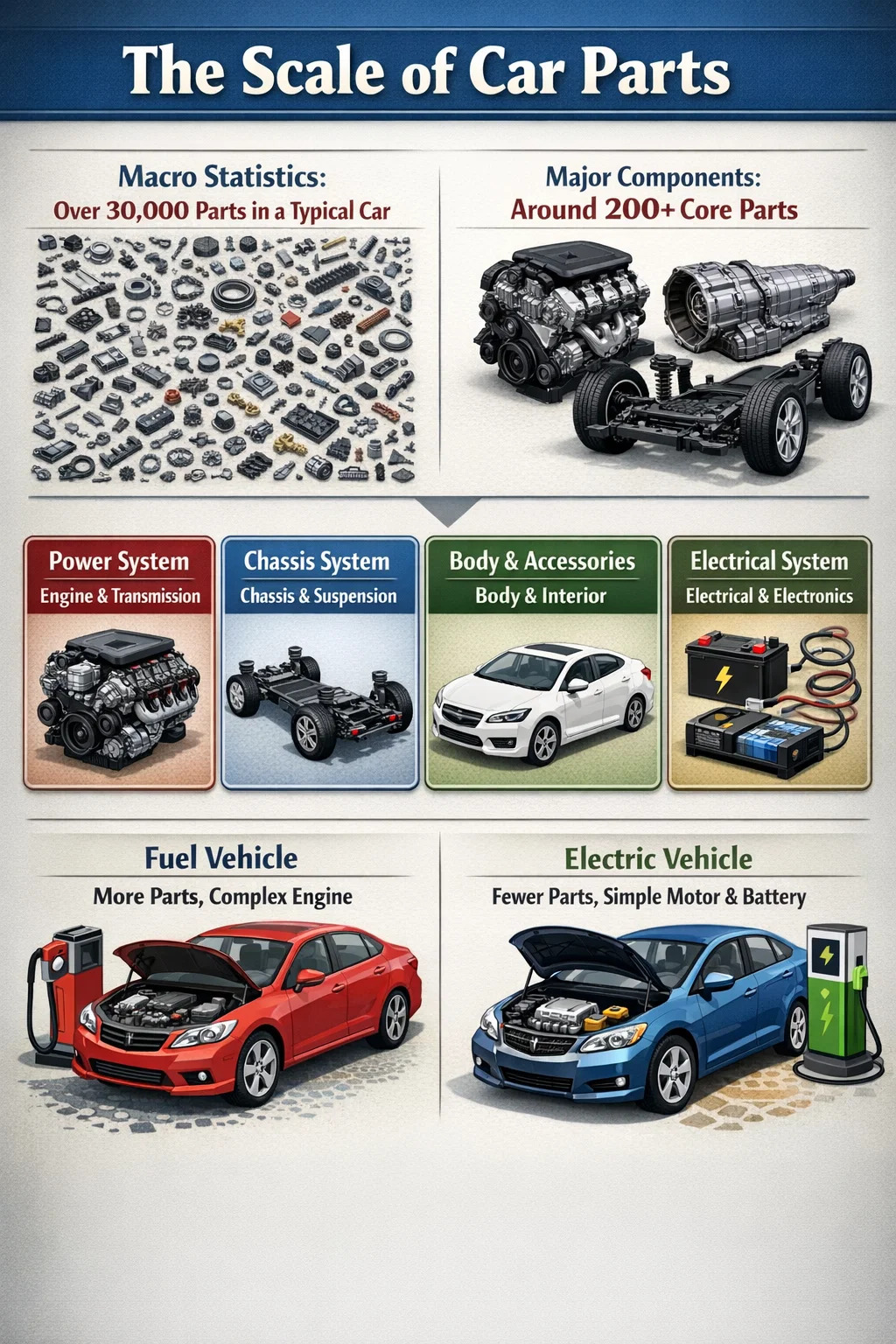
⇒ The Scale of Car Parts
▪ Macro Statistics:
If we disassemble a car down to its smallest components, counting every screw, washer, and wire as a separate part, a typical family car is usually assembled from tens of thousands of non-disassemblable individual auto parts. For extremely complex racing cars, this number can even double.
▪ Large Component Perspective:
If we change our perspective and consider complex mechanical assemblies like the engine, transmission, and chassis as single units, then a car consists of approximately several hundred core major components. This classification is closer to what we usually hear in repair shops.
⇒ Main Classification of Parts
For ease of management, these thousands of auto parts are usually categorized into four major systems:
▪ Power System (The Engine & Transmission):
This is the "heart" and "muscles" of the car. An engine alone contains thousands of tiny auto parts, including pistons, connecting rods, crankshafts, and valves. They work together to generate and transmit power.
▪ Chassis System (The Chassis):
This includes the suspension, steering, braking, and driving systems. Here we find familiar parts like brake pads, shock absorbers, steering gears, and tires. These auto parts support the car body and determine the driving experience.
▪ Body and Accessories (The Body):
This is the "skin" and "skeleton" of the car. It includes the car body, doors, windows, rearview mirrors, and the dashboard and seats inside the car. The body is not only for aesthetics but, more importantly, provides a safe space for passengers.
▪ Electrical System:
This is the "nervous system" of the car. From the battery and generator to complex wiring harnesses and sensors, these auto parts control the vehicle's lights, audio system, and various intelligent assistance functions.
⇒ Fuel Vehicles vs. Electric Vehicles
▪ Differences in the Number of Parts:
An interesting trend is that electric vehicles have significantly fewer auto parts than traditional fuel-powered vehicles. Because electric vehicles eliminate the complex internal combustion engine and exhaust system, replacing them with a relatively simple electric motor and battery pack, their structure is more compact, and the number of parts requiring maintenance is correspondingly reduced.