 English
 Español
Content
- 1 How Much Does It Cost to Paint a Car in 2026: The Direct Answer
- 2 2026 Paint Job Tiers: What Each Price Range Delivers
- 3 Why Prices Have Risen and What Is Pushing Them Higher in 2026
- 4 The Variables That Determine Your Specific Quote
- 5 How Long the Process Takes in 2026
- 6 The True Cost of DIY in 2026
- 7 Each Automobile Part and How It Affects Prep and Pricing
- 8 When Repainting Is Worth the Money and When It Is Not
- 9 How to Choose a Shop and Read a 2026 Quote Correctly
- 10 Maintaining a New Paint Job to Protect the Investment
How Much Does It Cost to Paint a Car in 2026: The Direct Answer
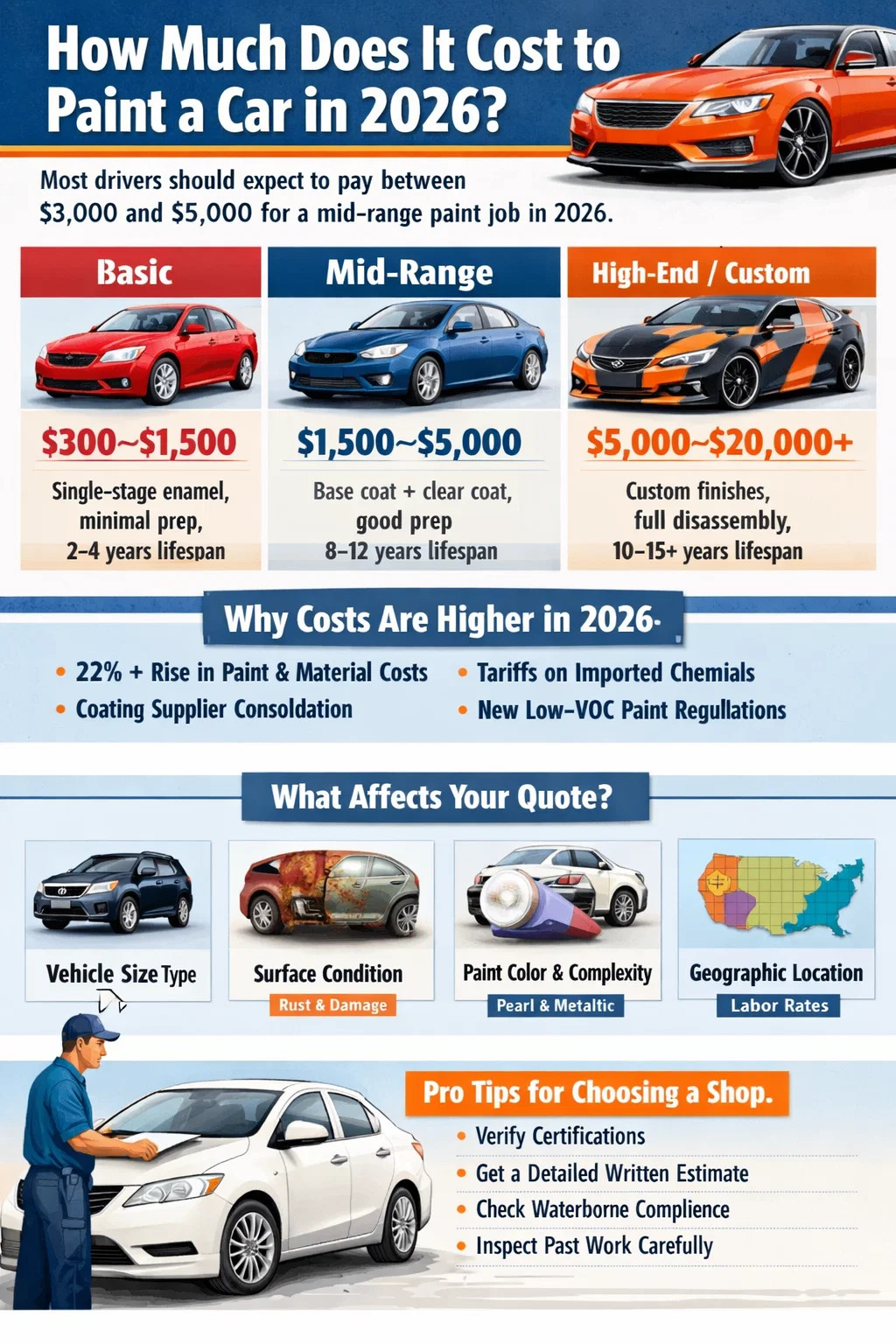
The short answer for 2026: most drivers should expect to pay between $3,000 and $5,000 for a solid mid-range paint job, with budget options starting around $300–$1,000 and premium or custom work reaching $10,000 to $20,000 or more. That mid-range benchmark has shifted upward compared to just a few years ago. Paint and material costs have climbed more than 22% since 2022, driven by inflation, tariffs on imported chemical compounds, EPA regulatory changes, and ongoing consolidation among the major coating suppliers. All of those pressures are continuing in 2026—meaning quotes you received even 18 months ago are likely no longer accurate.
One new factor specific to 2026 is regulatory. As of January 2026, auto body shops in California, New York, and Colorado are required by law to use low-VOC waterborne paint systems. These compliant materials cost 18–22% more than the older solvent-based formulas they replace, though they do reduce drying time and improve long-term finish durability. Shops in those states will reflect that cost in their estimates, and other states are expected to follow with similar mandates over the next few years.
The sections below cover what each price tier actually includes, which variables move the number up or down, and how to tell a genuinely good quote from one that looks competitive but cuts corners on the work that matters most.
2026 Paint Job Tiers: What Each Price Range Delivers
Automotive repaints fall into three clearly defined tiers. The difference between them is not just finish quality on the day you pick up the car—it is how the paint holds up over the next five to fifteen years under real driving conditions.
Basic Paint Jobs ($300–$1,500)
This tier uses single-stage synthetic enamel paint with minimal surface preparation. Non-visible surfaces—the underside of the hood, door jambs, trunk interiors—are left in their original color or skipped entirely. The finish can look acceptable initially, but enamel fades quickly under UV exposure and does not hold up well against moisture. Warranties are limited or nonexistent. This category makes financial sense for older vehicles where cosmetic improvement matters more than durability, or for cars where the cost of a higher-tier job would exceed the vehicle's actual market value.
Mid-Range Paint Jobs ($1,500–$5,000)
The majority of vehicle owners choose this tier. It includes thorough surface preparation, a proper primer coat, a high-quality base coat, and a UV-resistant clear coat applied in multiple layers. In 2026, mid-range shops certified under PPG or Axalta programs charge between $115 and $145 per hour in labor, while uncertified local shops typically run $65 to $95 per hour. The gap in hourly rate reflects real differences in technician training, equipment quality, and material standards. A well-executed mid-range job on a typical family sedan with no major rust or structural damage can last a decade or more with routine maintenance.
High-End and Custom Paint Jobs ($5,000–$20,000+)
Premium jobs involve complete disassembly of exterior components, bare-metal preparation, multi-stage urethane or ceramic finishes, and meticulous color matching under cross-light inspection. Custom designs—color-shifting pigments, airbrushed graphics, two-tone layouts—sit at the upper end of this bracket. Classic car restorations and show vehicles frequently land in the $10,000–$25,000 range, with concours-level work on rare vehicles going significantly higher. One industry specialist noted that a correctly executed 2026 waterborne respray at this level, maintained properly, can achieve 92% gloss retention over many years measured with calibrated instrumentation.
| Tier | 2026 Cost Range | Paint System | Expected Lifespan | Best For |
|---|---|---|---|---|
| Basic | $300–$1,500 | Single-stage synthetic enamel | 2–4 years | Older cars, short-term cosmetic fix |
| Mid-Range | $1,500–$5,000 | Base coat + clear coat (2-stage) | 8–12 years | Daily drivers, family vehicles |
| High-End / Custom | $5,000–$20,000+ | Urethane, ceramic, metallic, pearl | 10–15+ years | Luxury, collector, restoration cars |
Why Prices Have Risen and What Is Pushing Them Higher in 2026
Understanding why paint costs are elevated right now helps explain quotes that may seem high compared to what you paid or heard about five years ago. Several structural forces are at work simultaneously.
Material Cost Inflation and Tariff Pressure
Paint and material costs have risen more than 22% since 2022, according to industry data from major refinish brands. The causes include raw material inflation, higher shipping costs, and tariffs on imported organic compounds used in paint formulations. A manufacturer relying on imported pigments or chemical binders faces both higher input costs and unpredictable supply, which flows directly into the estimates shops provide to customers. KBB notes that all current paint job price estimates may be further impacted by ongoing tariff developments—meaning a quote received today could look different in three to six months if import costs shift.
Supplier Consolidation in the Coatings Market
A market that once supported a dozen or more global refinish suppliers is contracting through acquisition. As competition among coating companies decreases, the pricing pressure that once held down material costs eases. The coatings, toners, clears, reducers, and supporting products that shops buy become more vulnerable to upward price movement with fewer alternatives to turn to. This consolidation trend is accelerating into 2026 and is expected to continue affecting shop operating costs throughout the year.
New Regulatory Compliance Costs
As of January 2026, all auto body shops in California, New York, and Colorado must use low-VOC waterborne paint systems to comply with EPA and state air quality regulations. These systems cost 18–22% more in materials per job than the older solvent-based alternatives. Additional states are anticipated to follow with similar mandates. Shops that are not yet compliant face certification costs, equipment upgrades for spray booths designed to handle waterborne systems, and technician retraining. These costs are being passed on in estimates.
Skilled Labor Shortages
Industry data indicates that the majority of final-year students in U.S. automotive aftermarket technician training programs do not plan to enter the collision repair industry after graduation. The resulting shortage of experienced refinish technicians puts upward pressure on hourly labor rates at shops that maintain high standards. Shop labor rates in 2026 range from $75 to $200 per hour depending on certification level and market location, with certified centers at the upper end reflecting the cost of maintaining technician credentials and compliant equipment.
The Variables That Determine Your Specific Quote
The market average gives a starting point, but your final cost is shaped by conditions specific to your vehicle and location. Each of the following variables can move a quote significantly in either direction.
Vehicle Size and Number of Automobile Parts to Cover
Every exterior automobile part—hood, roof, doors, fenders, quarter panels, bumper covers, pillars, mirror housings—requires individual masking, preparation, and paint application. More surface area means more material, more labor hours, and longer shop time. A compact sedan might cost $2,000–$3,500 for a quality mid-range repaint, while a full-size SUV or truck in the same tier runs $3,500–$7,000. Each additional automobile part adds incrementally to the total, which is why SUVs, pickups, and vans consistently come in at the high end of any tier's range.
Condition of the Existing Surface and Body Panels
This is the single biggest wildcard in any estimate. A vehicle with light surface oxidation and no structural damage sits at the low end of prep costs. One with rust patches, deep scratches, dents, peeling prior paint, or body filler work requires extensive preparation before a single coat of new paint is applied. Industry professionals note that cars requiring significant bodywork can see total costs increase by 30% to 50% or more compared to a clean-surface job. A 2012 sedan with 30+ deep scratches and rocker panel rust can cost 2.7 times more than an identical vehicle with only light surface oxidation.
Paint Color and Formula Complexity
Standard solid colors—white, black, silver, gray—are the most affordable because they are widely stocked, require fewer coats for full coverage, and are the simplest to match for future touch-ups. Metallic and pearlescent finishes require precise multi-layer application and careful spray gun calibration, adding 8–12 labor hours over an equivalent solid-color job. Three-stage pearl or metallic paint is considerably more expensive in both materials and labor. Changing a vehicle's color from the original adds cost because door jambs, interior pillars, and partially visible edges must also be addressed for a convincing result—a full color change can increase total cost by 20% to 40%.
Geographic Location and Local Labor Market
Where you live has a direct, measurable impact on what you pay. High-cost urban markets—Los Angeles, San Francisco, New York, Boston—push two-stage jobs on compact cars to $3,000 or more. More competitive markets in Texas, Florida, and Ohio offer quality two-stage jobs in the $1,800–$2,500 range for the same vehicle. High-sun coastal markets like San Diego and Huntington Beach see faster UV degradation, so local shops often recommend—and price in—stronger UV-resistant clear coats and more thorough prep. Rural independent shops may quote under $1,500, but equipment quality and material compliance should be verified before committing.
Plastic vs. Metal Automobile Parts
Bumper covers and other plastic automobile parts cost more per square foot to refinish than metal panels of identical size. Plastic requires a specialized adhesion promoter in the primer coat, and a flex agent must be mixed into the paint itself to prevent cracking when the bumper flexes under minor impacts. Skipping these steps produces a paint job that chips and peels within months on plastic components. This is a common quality differentiator between budget shops and professional-grade auto body operations.
Scope: Full Repaint vs. Single Panel Repair
Repainting a single damaged door or fender after an accident costs considerably less than a full vehicle repaint—typically $500 or more per panel depending on prep requirements and paint complexity. The challenge with partial repaints is color blending. Vehicle paint fades over time, and matching fresh paint to aged surrounding panels demands skill, proper blending technique, and good cross-light inspection capability. Shops using computerized OEM paint-code matching systems produce better blends than those mixing by eye. A poor match is immediately visible in direct sunlight and can reduce resale value.
How Long the Process Takes in 2026
Time in the shop is a real cost beyond the invoice—your vehicle is unavailable for daily use while the work is underway. The new low-VOC waterborne systems required in regulated states actually reduce drying time compared to older solvent-based paints, so shops using compliant materials can sometimes complete jobs slightly faster. General timelines remain:
- Basic paint job: 1 to 2 days. Minimal prep, fast-drying single-stage enamel, limited coats.
- Mid-tier paint job: 3 to 5 days. Primer coats, proper flash time between layers, base coat and clear coat with controlled curing.
- Premium or custom paint job: 1 to 2 weeks, or up to 4 weeks for full showroom-quality restoration. Includes disassembly of components, wet sanding between layers, and final polishing.
Shops promising a full repaint in under 24 hours at a budget price are compressing or skipping the preparation and curing stages. Industry data from 2026 shows that 68% of repaints done by non-certified shops required correction within 18 months due to improper curing, inadequate rust inhibition, or material substitutions that compromised film integrity. The short-term savings typically disappear once rework labor and diminished resale value are factored in.
The True Cost of DIY in 2026
DIY car painting appeals to cost-conscious owners, but the actual investment required to do it properly is higher than most people expect, and the result almost never matches even a basic professional job. Getting a quality DIY repaint done at home requires:
- A quality spray gun and compatible air compressor: $200–$800 for entry-level equipment
- Automotive primer, base coat, and clear coat materials: $150–$600 depending on vehicle size and paint type
- Sandpaper in multiple grits, tack cloths, masking tape and paper: $50–$200
- A clean, temperature-controlled, dust-free space: difficult to source without a rented spray booth
- VOC-compliant waterborne materials if you are in a regulated state (California, New York, Colorado): higher cost than older solvent formulas
Total material costs for a real DIY repaint commonly reach $500–$1,200 before accounting for mistakes that require additional sanding and recoating. The finished result almost always shows orange peel texture, dust inclusion, or uneven metallic flake distribution. Touch-up pens and DIY kits ($25–$75) are only suitable for sealing small stone chips to prevent rust—they will not produce a cosmetically acceptable repair on anything larger. For most car owners, professional work provides better long-term value even when the upfront invoice is higher.
Each Automobile Part and How It Affects Prep and Pricing
A full repaint quote reflects the cumulative effort required across every exterior automobile part. Knowing which components drive the most time and material cost helps you understand why estimates vary so significantly between vehicles.
The hood and roof are large flat panels—they take significant paint volume but are straightforward to access. Fenders and quarter panels require precise masking around headlights, marker lights, and wheel arches. The bumper cover—a plastic automobile part—demands both adhesion promoter and flex agent, adding cost compared to metal panels of equivalent size. Doors involve the exterior skin, edges, and jambs if a thorough job is specified. Pillars and mirror housings are small but time-consuming to prep and mask without overspray lines. Each rocker panel, an automobile part that runs along the lower edge of the body between the wheel arches, is particularly prone to rust from road salt and stone chips—if rust is present there, the prep work and potential structural repair add substantially to the total bill.
When any automobile part carries prior collision repair history—old body filler, aftermarket replacement panels, or mismatched factory primers—the painter must address those inconsistencies before applying the final color coats. This is one of the most common reasons a final invoice exceeds the initial estimate. A thorough shop will identify these issues during the pre-job inspection and include them in a written estimate; a shop that skips this step is setting up for a callback within a year or two.
When Repainting Is Worth the Money and When It Is Not
Not every vehicle benefits equally from a full repaint. Deciding whether to invest requires an honest assessment of the car's current value, condition, and how long you plan to keep it.
Protecting Against Rust and Structural Damage
Paint is not purely cosmetic. It is the primary protective barrier for metal body panels. When the clear coat fails or chips occur, bare steel is exposed to moisture. Rust spreads laterally under surrounding paint, growing far beyond the original damage point. Addressing paint damage promptly on rust-prone automobile parts—rocker panels, lower door edges, wheel arches, and trunk floors—prevents structural repairs that cost far more than the original paint touch-up would have.
Resale Value and the ROI Question
A new paint job improves visual appeal but rarely adds dollar-for-dollar value at sale. Spending $4,000 on a repaint for a vehicle worth $6,000 is unlikely to yield a $4,000 increase in the sale price. Paint investment makes clearer financial sense on vehicles with strong underlying market value—low mileage, excellent mechanical condition—where exterior appearance is the primary barrier to achieving a higher asking price. One documented example shows that preserving factory VIN-tagged paint documentation and avoiding unnecessary repaints added $1,100 in resale value when the vehicle was sold.
Insurance-Covered Paint Work
If paint damage resulted from a covered accident, comprehensive claim, or vandalism, the cost of refinishing the affected automobile part is typically covered by insurance minus the applicable deductible. A professional auto body shop can assist with documentation and the claims process to ensure correct materials and labor are properly reimbursed. It is worth noting that elevated used-car values in 2026 continue to push insurers toward declaring more borderline vehicles as total losses rather than approving repair—meaning some vehicles that would have been repaired in previous years are now being written off instead.
Classic and Collector Vehicles
For collector vehicles, restoration-quality paint work is both an aesthetic and financial priority. Show judges and informed buyers evaluate finish quality with a level of scrutiny that makes any shortcut immediately apparent. Using the wrong factory color code, skipping period-correct materials, or accepting a substandard application on any exterior automobile part directly affects appraised value and show points. Premium restoration shops commonly charge $10,000–$25,000, with concours-level work on rare vehicles exceeding $50,000.
How to Choose a Shop and Read a 2026 Quote Correctly
Two shops quoting the same dollar amount for the same vehicle can deliver completely different results. The quote total is far less informative than what it actually includes. Before signing any estimate, work through the following steps:
- Verify shop certifications. Confirm active PPG, Axalta, or BASF certification and ask for the technician's refinish credentials, not just a general body tech designation. Certified technicians in 2026 undergo recertification every 90 days at major-brand collision centers.
- Ask specifically whether the shop uses waterborne or solvent-based systems, and whether it is compliant with current state VOC regulations. Non-compliant materials in regulated states can affect both the legality of the work and the long-term performance of the finish.
- Request a written estimate that specifies paint brand and system, number of coats, prep steps, and warranty terms. Verbal quotes are unreliable, and legitimate shops will provide full written breakdowns.
- Ask how color matching is handled. Shops using spectrophotometer-based computerized OEM paint code matching produce far more accurate blends than those mixing by eye, particularly for partial repaints.
- Confirm whether non-visible surfaces—door jambs, under-hood areas, trunk interiors—are included, or whether those areas will retain the original color or be masked off.
- Inspect finished work from previous jobs under direct light, not just photos. Orange peel texture, dust inclusion, and uneven metallic flake distribution are defects that only show clearly in strong directional light.
- Document your vehicle's condition thoroughly with dated photos before drop-off, noting every existing scratch, dent, and rust spot to prevent disputes about pre-existing damage.
Getting three written quotes is the most reliable way to establish fair market pricing for your specific vehicle and quality expectation. A wide spread between quotes—one at $1,200 and another at $4,500 for identical scope—almost always signals that the lower bid excludes significant prep work, uses cheaper non-compliant materials, or both.
Maintaining a New Paint Job to Protect the Investment
Even an expensive, professionally applied paint job degrades faster than it should without consistent basic maintenance. The habits below extend the lifespan of a new finish significantly:
- Wash regularly using pH-neutral soap and hand washing technique. Automatic car washes with rotating brushes accelerate clear coat micro-scratching by up to 400% compared to hand washing, according to 2026 industry data.
- Apply a quality wax or paint sealant every three to six months to maintain UV protection. For premium finishes, biannual professional ceramic coating renewal delivers the best long-term gloss retention.
- Address stone chips and scratches immediately with touch-up paint before moisture reaches bare metal on any automobile part, particularly on lower panels and rocker areas.
- Remove bird droppings, tree sap, and road salt promptly. These are chemically aggressive to clear coat and will etch the surface permanently if left for more than a few days.
- Park in a garage or covered area whenever possible to limit cumulative UV exposure, which is the primary cause of oxidation and color fade over time.
With proper maintenance, a quality 2026 mid-range or premium paint job should last 10–15 years. Neglect the same finish, and visible oxidation and micro-cracking can appear within three to five years—returning the vehicle to the shop for another repaint ahead of schedule and at the higher costs now characteristic of the 2026 market.