 English
 Español
Content
Core Components: The Primary Anatomy of a Light Fixture
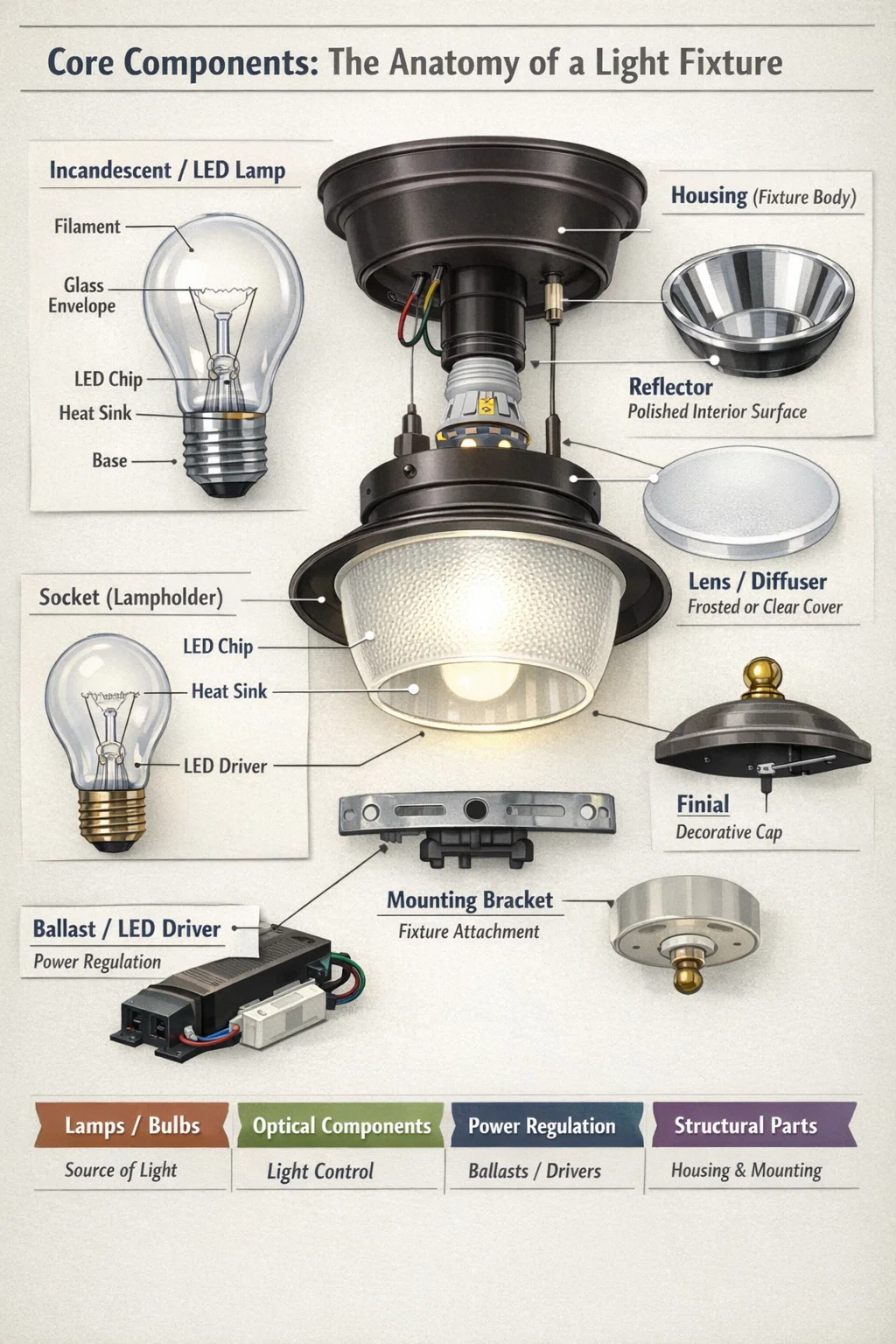
A light fixture, often referred to in technical terms as a luminaire, is composed of several distinct lighting parts that work in unison to provide illumination. The most fundamental parts include the lamp (bulb), the socket, the housing (fixture body), and the lens or diffuser. While the bulb creates the light, the other components are responsible for holding the bulb in place, protecting it, and directing the light beam to the desired area.
In more complex setups, such as industrial or commercial systems, lighting parts like ballasts, drivers, and reflectors become critical. Understanding these terms is essential for anyone involved in home maintenance, interior design, or electrical repair, as it allows for precise communication when sourcing replacements or troubleshooting a flicker.
The Source of Illumination: Lamps and Bulbs
In the lighting industry, the "bulb" is technically called a lamp. This is the replaceable component that converts electrical energy into visible light. There are various technologies used in these lighting parts, each with its own internal structure.
Internal Parts of a Standard Incandescent or Halogen Bulb
- Filament: The coiled tungsten wire that glows when heated.
- Glass Envelope: The outer shell that protects the internal elements and contains inert gases.
- Base: The threaded or pinned part that connects to the electrical power, often made of brass or aluminum.
LED Lighting Components
Modern LED (Light Emitting Diode) lighting parts differ significantly. They consist of a semiconductor chip (the die), a heat sink to dissipate warmth, and an electronic driver that converts AC voltage to the DC voltage required by the LEDs.
The Infrastructure: Sockets, Holders, and Wiring
The mechanical and electrical interface of the light is managed by the socket. This part ensures that the lamp remains securely attached to the fixture while transferring power safely.
| Component Name | Function | Common Material |
|---|---|---|
| Socket (Lampholder) | Holds the lamp and provides electrical contact | Porcelain, Phenolic, or Plastic |
| Terminal Screws | Secures electrical wires to the socket | Brass or Steel |
| Mounting Bracket | Attaches the fixture to the wall or ceiling | Galvanized Steel |
The Optical Assembly: Reflectors, Lenses, and Louvers
Light on its own is often chaotic and inefficient. Optical lighting parts are used to control the direction and quality of the light. A reflector is a polished surface, typically made of aluminum or mirrored plastic, positioned behind the lamp to bounce light forward. These are common in flashlights and recessed "can" lights.
The lens or diffuser is the translucent or transparent cover that sits in front of the lamp. Its primary job is to protect the bulb and scatter the light to prevent harsh glares. For instance, a frosted glass diffuser can reduce glare by up to 40% compared to an exposed bulb, creating a much softer ambient light.
Baffles and Louvers
In commercial lighting, louvers are used to shield the light source from direct view at certain angles. These grid-like lighting parts are essential in office environments to prevent reflections on computer screens and improve overall visual comfort.
Power Regulation: Ballasts and Drivers
Fluorescent and HID (High-Intensity Discharge) lamps cannot be connected directly to a standard power outlet because they require a high starting voltage. The ballast is a critical member of the lighting parts family that regulates the current to the lamp and provides the necessary voltage to start the arc.
With the shift toward solid-state lighting, the LED driver has taken over. This component acts as the "brain" of the fixture, managing the power supply and often enabling dimming capabilities. A high-quality driver can extend the life of an LED fixture to over 50,000 hours by maintaining a steady current and protecting against power surges.
The External Structure: Housing and Finial
The housing is the physical shell of the light. It serves as the chassis where all other lighting parts are mounted. In outdoor lighting, the housing must be "wet-rated," meaning it is sealed with gaskets to prevent water ingress.
On decorative lamps, you might encounter a finial. This is the small decorative nut that screws onto the top of the lamp harp to hold the lampshade in place. While small, it is one of the most frequently lost lighting parts during a move or redecoration process.
Summary of Accessory Parts
- Harp: The U-shaped metal wire that supports a lampshade.
- Canopy: The plate that covers the electrical box in the ceiling.
- Trim: The visible portion of a recessed light that sits flush with the ceiling.