 English
 Español
Content
- 1 The Light Source: Where It All Begins
- 2 The Luminaire: Housing All the Lighting Parts Together
- 3 Ballasts and Drivers: The Power Management Components
- 4 Reflectors: Directing and Shaping the Light Output
- 5 Lenses and Diffusers: Controlling Light Quality and Distribution
- 6 The Housing and Heat Management System
- 7 Lighting Control Systems: Managing When and How Light Works
- 8 Wiring and Electrical Components
- 9 Key Lighting Parts Compared: A Reference Overview
- 10 Color Temperature and Color Rendering: Performance Metrics That Define Light Quality
- 11 How Lighting Parts Work Together in a Complete System
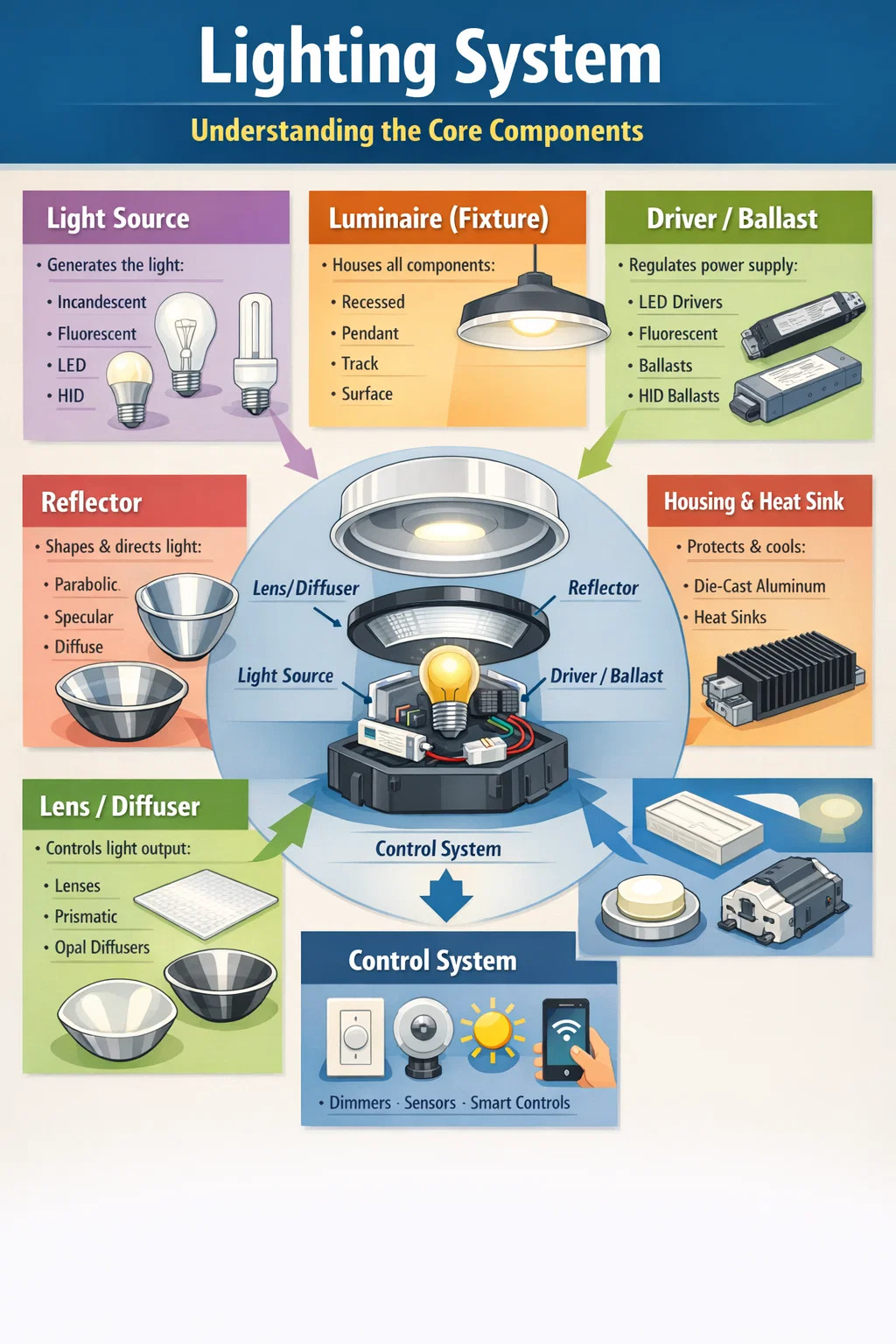
Lighting is not just about illumination — it is a carefully engineered system made up of distinct, interdependent components. The core components of lighting include the light source, luminaire (fixture), ballast or driver, reflector, lens or diffuser, housing, and control system. Each part plays a specific role in determining how light is produced, shaped, distributed, and managed. Whether you are designing a home lighting plan, setting up a commercial space, or troubleshooting an existing installation, understanding these parts gives you a decisive advantage.
The Light Source: Where It All Begins
The light source is the component that actually generates light. It is the most recognizable part of any lighting system, and the technology behind it has changed dramatically over the past few decades.
Incandescent Bulbs
The traditional incandescent lamp works by passing electrical current through a tungsten filament until it glows. These bulbs have a color rendering index (CRI) of 100, meaning colors under incandescent light appear exactly as they do in natural sunlight. However, incandescent bulbs convert only about 10% of energy into visible light, with the remaining 90% lost as heat. They are largely being phased out in favor of more efficient technologies.
Fluorescent Lamps
Fluorescent lamps operate by exciting mercury vapor, which produces ultraviolet light that then activates a phosphor coating to emit visible light. They are significantly more efficient than incandescent lamps — a 32W T8 fluorescent tube produces roughly the same light output as a 75W incandescent bulb. Common applications include offices, schools, and commercial spaces. Compact fluorescent lamps (CFLs) brought this technology into residential settings.
LED (Light Emitting Diode) Sources
LED technology is now the dominant light source across virtually all applications. LEDs can achieve luminous efficacies exceeding 200 lumens per watt, compared to approximately 15 lm/W for incandescent bulbs. They have operational lifespans of 25,000 to 100,000 hours, contain no mercury, and are available in a wide range of color temperatures from warm 2700K to daylight 6500K. A standard LED bulb that replaces a 60W incandescent typically consumes only 8–10 watts.
High-Intensity Discharge (HID) Sources
HID lamps include metal halide, high-pressure sodium (HPS), and mercury vapor lamps. These are used primarily in outdoor and industrial environments where high light output over large areas is needed. A 400W metal halide lamp, for instance, can produce around 36,000 lumens. HID sources require a warm-up period of several minutes before reaching full brightness.
The Luminaire: Housing All the Lighting Parts Together
The luminaire — commonly called a light fixture — is the complete unit that houses and supports the light source along with all associated components. The design of a luminaire directly affects both the aesthetic and functional performance of a lighting installation.
Luminaires are classified by their mounting type, light distribution pattern, and intended environment. Common mounting types include:
- Recessed fixtures — installed into ceilings or walls for a flush, low-profile look
- Surface-mounted fixtures — attached directly to a surface without recessing
- Pendant fixtures — hung from the ceiling via a cord, rod, or chain
- Track lighting fixtures — mounted on an electrified track, allowing repositioning
- Pole-mounted or post-top fixtures — used outdoors for area lighting
The luminaire body also provides mechanical protection for the lamp and electrical components, and in outdoor or industrial environments, IP (Ingress Protection) ratings determine how well the fixture resists dust and moisture. For example, an IP65-rated luminaire is fully dust-tight and protected against water jets, making it suitable for exterior applications.
Ballasts and Drivers: The Power Management Components
Not all light sources can connect directly to a standard electrical supply. Many require a device that regulates the electrical current flowing to the lamp. These devices are the ballast (for fluorescent and HID lamps) and the driver (for LEDs).
Ballasts for Fluorescent and HID Lamps
A ballast limits and regulates the current in fluorescent and HID circuits. Without it, these lamps would draw increasing current until they fail. Magnetic ballasts were the standard for decades, but electronic ballasts have largely replaced them due to their higher efficiency, reduced flicker, and silent operation. Electronic ballasts for T8 fluorescent lamps typically operate at frequencies of 20,000 Hz or higher, completely eliminating the 100/120 Hz flicker associated with magnetic types.
LED Drivers
An LED driver converts AC mains voltage into the DC voltage and current that LEDs require. LEDs are highly sensitive to current fluctuations — even a small overcurrent can significantly reduce lifespan or cause immediate failure. Constant-current drivers are the most common type, supplying a fixed current (typically 350mA, 700mA, or 1050mA) regardless of voltage changes. Constant-voltage drivers supply a fixed voltage (usually 12V or 24V DC) and are used in applications like LED strip lighting. Dimmable drivers allow integration with dimming control systems, which is a critical feature for many modern installations.
Reflectors: Directing and Shaping the Light Output
A light source on its own emits light in all directions. Reflectors redirect and concentrate that light toward the target area, dramatically increasing the useful light output and improving efficiency. The geometry and surface finish of a reflector determine the distribution pattern of the light.
Common reflector shapes include:
- Parabolic reflectors — produce a narrow, parallel beam of light, ideal for spotlights and floodlights
- Elliptical reflectors — concentrate light at a focal point, used in theatrical and display lighting
- Specular (mirror-finish) reflectors — produce sharp, defined beams with high efficiency but potential glare
- Matte or diffuse reflectors — scatter light more broadly, reducing harsh shadows
Reflector materials include polished aluminum (reflectivity of 85–95%), silver-coated aluminum (up to 98% reflectivity), and white painted surfaces (approximately 70–85% reflectivity). The choice of material affects both the quantity and quality of reflected light.
Lenses and Diffusers: Controlling Light Quality and Distribution
Lenses and diffusers are optical components placed in front of the light source to modify how light exits the fixture. They serve both practical and aesthetic purposes.
Lenses
Lenses refract light to change its direction and beam angle. Fresnel lenses, commonly found in theatrical and film lighting, use concentric rings to produce a soft-edged beam while remaining lightweight and thin. Prismatic lenses, often used in office troffers and industrial luminaires, redirect downward light to a wider distribution, improving uniformity across a workspace. Beam-shaping lenses for LED modules allow precise control of beam angles from as narrow as 10° to as wide as 120°.
Diffusers
Diffusers scatter light to reduce glare and create softer, more even illumination. Opal (milky white) diffusers are among the most common and provide a uniform, glare-free appearance. Prismatic diffusers offer more light transmission than opal types while still reducing direct view of the light source. Micro-prismatic diffusers are a refined version that transmits up to 92% of light while effectively hiding the lamp from view. In LED panel lights, diffusers are critical for masking the individual LED dots and creating a smooth, uniform surface.
The Housing and Heat Management System
The housing of a lighting fixture protects internal components from physical damage and environmental factors. But in LED lighting especially, the housing also serves a critical thermal management function. Heat is the primary enemy of LED performance and longevity.
LED junction temperature — the temperature at the semiconductor itself — directly affects lumen output and lifespan. For every 10°C rise in junction temperature above the rated maximum, the LED's lifespan can be reduced by approximately 50%. Effective thermal management strategies include:
- Heat sinks — aluminum fins or plates that conduct and dissipate heat away from the LED
- Thermal interface materials (TIMs) — thermally conductive pastes or pads placed between the LED and heat sink
- Metal-core PCBs (MCPCBs) — circuit boards with an aluminum or copper base layer that spreads heat rapidly
- Active cooling fans — used in very high-power applications where passive cooling is insufficient
The housing material also matters. Die-cast aluminum is widely used due to its excellent thermal conductivity (around 96–230 W/m·K depending on alloy), durability, and relatively low weight. Polycarbonate and other plastics are used for lower-power applications where thermal demands are minimal.
Lighting Control Systems: Managing When and How Light Works
Control systems are an increasingly important component of modern lighting. They govern when lights turn on and off, at what intensity they operate, and how they respond to environmental conditions or user inputs. Effective lighting control can reduce energy consumption by 30% to 60% compared to uncontrolled systems.
Dimmers
Dimmers reduce the voltage or current supplied to a lamp to lower its output. For LED systems, phase-cut dimmers (TRIAC dimmers) and 0–10V analog dimmers are the most common types. It is essential to match the dimmer type with the LED driver specifications, as incompatible combinations result in flicker, limited dimming range, or lamp failure. A quality LED dimming system should be capable of dimming smoothly from 100% down to at least 1% without visible flicker or noise.
Occupancy and Motion Sensors
Occupancy sensors automatically turn lights on when presence is detected and off after a defined period of inactivity. Passive infrared (PIR) sensors detect changes in infrared radiation from moving warm bodies. Ultrasonic sensors detect motion through sound wave reflection, making them effective in spaces with obstructions. Dual-technology sensors combine both methods for greater accuracy. In commercial offices, occupancy sensors alone typically reduce lighting energy use by 25–50%.
Daylight Harvesting Systems
These systems use photosensors to measure ambient daylight levels and automatically dim or switch off electric lights when natural light is sufficient. In a south-facing perimeter zone of a commercial building, daylight harvesting can reduce lighting energy consumption by 40–70% during daylight hours.
Smart and Networked Lighting Controls
Modern smart lighting systems allow individual fixtures or groups to be programmed, monitored, and adjusted remotely. Protocols such as DALI (Digital Addressable Lighting Interface), DMX512 (used in entertainment lighting), Zigbee, and Bluetooth Mesh enable sophisticated scene management and energy reporting. In large commercial installations, these systems provide detailed data on usage patterns, enabling ongoing optimization.
Wiring and Electrical Components
Behind every lighting installation is an electrical infrastructure that includes wiring, junction boxes, circuit breakers, and transformers. These are not always visible, but their specification directly affects safety and performance.
Low-voltage LED systems, particularly those running on 12V or 24V DC, require the appropriate transformer or power supply to step down from mains voltage. Wire gauge must be correctly specified to handle the current load without excessive voltage drop. For example, in a 24V LED system running 50 watts of load at 10 meters, using undersized wire (e.g., 0.5mm²) can cause a voltage drop of more than 2V, visibly reducing LED brightness and potentially causing color inconsistency.
Circuit protection in the form of fuses or circuit breakers prevents damage from overloads or short circuits. Ground fault circuit interrupters (GFCIs) are required in wet or damp locations to prevent electric shock.
Key Lighting Parts Compared: A Reference Overview
| Component | Primary Function | Common Materials/Types | Key Specification |
|---|---|---|---|
| Light Source | Generate visible light | LED, fluorescent, HID, incandescent | Lumens, wattage, CCT, CRI |
| Luminaire | House and support all parts | Recessed, pendant, track, surface | IP rating, mounting type |
| Ballast/Driver | Regulate electrical supply | Electronic ballast, constant-current LED driver | Output current/voltage, dimming compatibility |
| Reflector | Direct and concentrate light | Polished aluminum, silver-coated, white paint | Reflectivity %, beam angle |
| Lens/Diffuser | Modify light distribution and reduce glare | Fresnel, prismatic, opal, micro-prismatic | Light transmission %, beam spread |
| Housing/Heat Sink | Protect components, manage heat | Die-cast aluminum, polycarbonate | Thermal conductivity, IP rating |
| Control System | Manage light output and scheduling | Dimmer, occupancy sensor, DALI, Zigbee | Dimming range, protocol compatibility |
Color Temperature and Color Rendering: Performance Metrics That Define Light Quality
While not physical components in the same sense, color temperature and color rendering index (CRI) are fundamental specifications tied to the light source that determine how a space looks and feels under a given lighting system.
Color Temperature (CCT)
Measured in Kelvin (K), color temperature describes the apparent warmth or coolness of white light. Warm white (2700K–3000K) creates a cozy, relaxing atmosphere suited to bedrooms and restaurants. Neutral white (3500K–4000K) is common in offices and retail. Cool daylight (5000K–6500K) promotes alertness and is used in task-intensive environments like laboratories or workshops. The wrong color temperature for a given application can make spaces feel unwelcoming or reduce productivity.
Color Rendering Index (CRI)
CRI measures how accurately a light source renders colors compared to a reference light source, on a scale of 0 to 100. A CRI of 80 is considered the minimum acceptable for most commercial applications, while CRI 90+ is recommended for retail, galleries, medical facilities, and anywhere color accuracy is critical. High-CRI LEDs are available but typically at a premium cost and sometimes slightly lower efficiency than their lower-CRI counterparts.
How Lighting Parts Work Together in a Complete System
Understanding individual components is valuable, but the real performance of a lighting installation depends on how well these parts work together. A high-quality LED chip paired with a poorly designed driver will underperform. A well-specified reflector paired with an improperly matched lens can create unwanted artifacts. And even the best luminaire delivers poor results if the control system is incompatible or the thermal management is insufficient.
For example, consider a retail clothing store. The goal is to make garments look vibrant and appealing. The ideal system might include:
- A high-CRI (CRI 95+) LED source at 3000K to render fabric colors accurately with a warm, inviting tone
- A reflector with a 25–35° beam angle to concentrate light on merchandise displays without spilling onto walls
- A constant-current LED driver with 0–10V dimming capability to allow mood adjustments throughout the day
- A track luminaire mounted on a ceiling grid for flexibility in repositioning as merchandise arrangements change
- A daylight harvesting sensor near storefront windows to reduce energy consumption when natural light is adequate
Each component has been selected to serve the overall design intent. Changing any one of them — say, substituting a CRI 80 source to save cost — degrades the end result in a way that affects the customer experience and potentially sales performance.
This systems thinking is what separates a functional lighting installation from an excellent one. Whether you are specifying for a single room or an entire building, evaluating each lighting part against the requirements of the space — and confirming compatibility between components — is the foundation of good lighting design.