 English
 Español
Content
- 1 Start With Your Vehicle Identification Number (VIN)
- 2 OEM vs. Aftermarket vs. Remanufactured: Understanding Your Options
- 3 How to Use Part Numbers to Find Exact Matches
- 4 Where to Buy Car Parts: A Channel-by-Channel Breakdown
- 5 Parts Sourcing by Category: What to Prioritize for Each Type
- 6 How to Verify Fitment Before You Buy
- 7 Decoding Trim Levels and Option Packages That Affect Parts Compatibility
- 8 Quality Indicators to Look for When Evaluating an Automobile Part
- 9 Finding Parts for Older, Rare, or Discontinued Vehicles
- 10 Avoiding Common Mistakes When Buying Car Parts
- 11 Using Online Resources and Communities to Source the Right Auto Parts
Finding the right parts for your car comes down to one non-negotiable starting point: you must know your vehicle's year, make, model, engine size, and trim level before searching for any automobile part. Without this information, even a part that looks identical can fail to fit or function correctly. Once you have those details locked down, the process becomes far more straightforward — whether you're buying from a dealership, an online retailer, a salvage yard, or an auto parts store. This guide walks through every step of that process with practical detail.
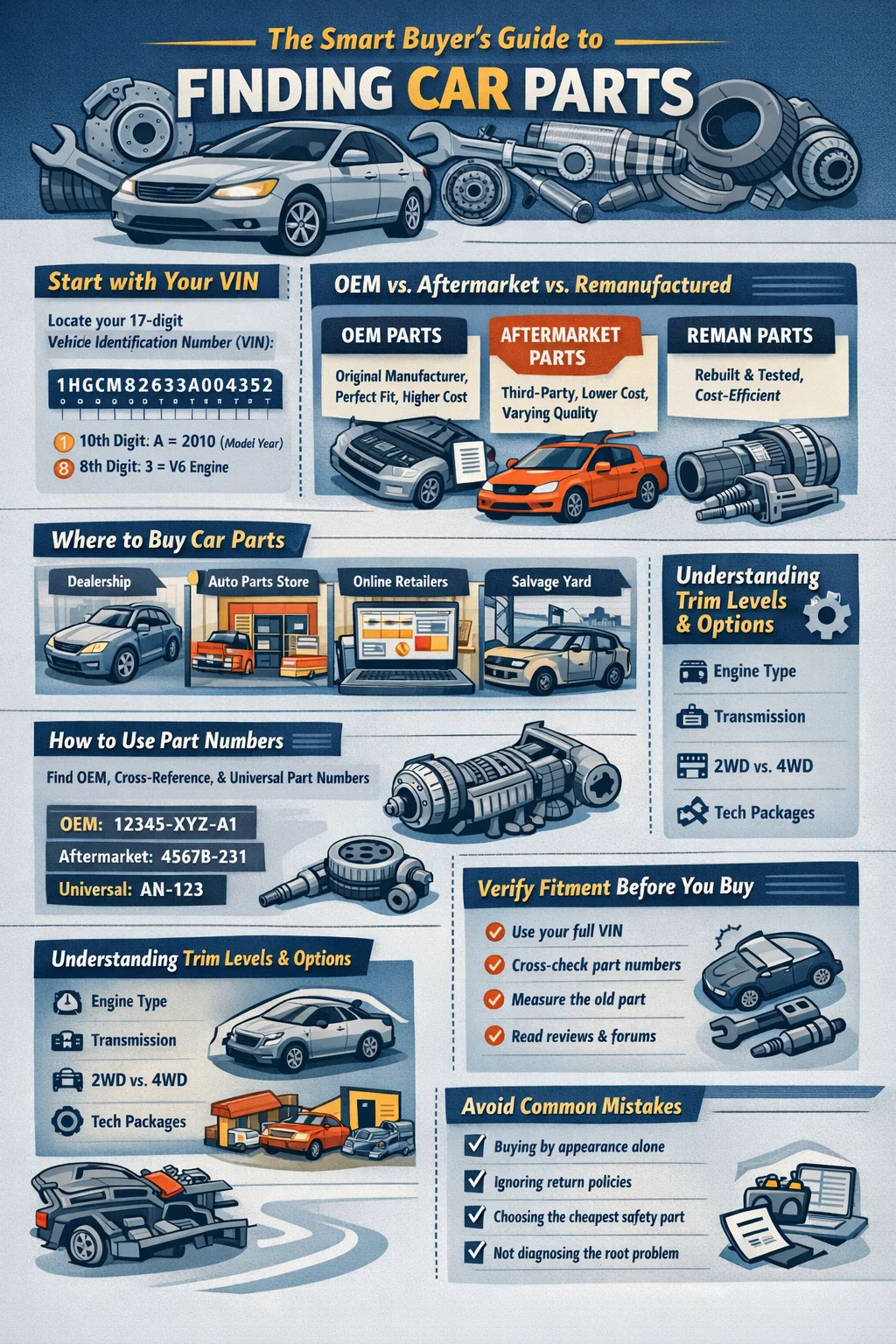
Start With Your Vehicle Identification Number (VIN)
The VIN is the single most reliable identifier for your vehicle. It is a 17-character alphanumeric code that encodes the manufacturer, vehicle type, model year, plant of manufacture, and a unique serial number. Every automobile part lookup should begin here.
You can find your VIN in several locations:
- On the driver's side dashboard, visible through the windshield at the base
- On the driver's side door jamb sticker
- On your vehicle registration or insurance card
- On the engine block itself (stamped directly into the metal)
- On the firewall under the hood
When you enter your VIN into parts lookup tools — whether on sites like RockAuto, AutoZone, or the OEM's own parts portal — it eliminates guesswork entirely. The system retrieves an exact vehicle profile and filters out incompatible parts automatically. This single step prevents the most common and costly mistake in auto parts sourcing: buying a part that doesn't fit.
Position 10 of the VIN represents the model year, and position 8 indicates the engine type. Knowing how to decode these characters can help you double-check that a part's listing matches your actual vehicle build, not just the model name.
OEM vs. Aftermarket vs. Remanufactured: Understanding Your Options
Once you have your vehicle details, the next decision is what type of automobile part to buy. The three main categories differ significantly in price, quality, sourcing, and appropriate use cases.
OEM (Original Equipment Manufacturer) Parts
OEM parts are made by the same manufacturer that supplied the component for your car's original assembly, or by the automaker's own parts division. They carry the vehicle brand's part number and are guaranteed to fit and function exactly as the original. The trade-off is cost — OEM parts typically run 20% to 60% more expensive than equivalent aftermarket options. For safety-critical components like airbag modules, ABS actuators, or electronic control units (ECUs), OEM is usually the recommended choice because calibration and compatibility are exact.
Aftermarket Parts
Aftermarket car parts are produced by third-party manufacturers and designed to match or exceed OEM specifications. Quality varies considerably across brands. Established aftermarket manufacturers like Bosch, Denso, Monroe, Gates, and ACDelco produce parts that frequently meet or surpass OEM standards. In contrast, no-name budget parts sourced from unreliable suppliers can fail prematurely and even cause secondary damage. For mechanical wear items — brake pads, filters, belts, spark plugs, suspension components — quality aftermarket parts are a sound choice and can offer genuine performance upgrades over OEM.
Remanufactured (Reman) Parts
Remanufactured parts are used cores that have been completely disassembled, cleaned, inspected, rebuilt with new wear components, and tested to meet original performance specifications. Common reman parts include alternators, starters, brake calipers, power steering racks, and transmissions. Reman parts can cost 40–70% less than new OEM equivalents while delivering comparable reliability when sourced from reputable remanufacturers. Many come with warranties of 12 months or more. A core charge is usually applied at purchase and refunded when you return the old part.
Used/Salvage Parts
Used parts pulled from salvage vehicles are the most affordable option, sometimes costing 70–80% less than new OEM. They are most appropriate for body panels, trim pieces, glass, interior components, and mechanical parts from low-mileage donor vehicles. The risk is that wear and remaining service life are unknown. Always ask for the donor vehicle's mileage and request photos of the part before purchasing remotely.
How to Use Part Numbers to Find Exact Matches
Part numbers are the most precise way to identify and source a specific automobile part. There are several types of part numbers you will encounter:
- OEM part numbers — assigned by the vehicle manufacturer, printed on the existing part or found in the OEM parts catalog
- Aftermarket cross-reference numbers — assigned by aftermarket suppliers and cross-referenced to OEM numbers
- Universal part numbers — used for generic parts like nuts, bolts, filters, and fluids
To find an OEM part number, you can consult the vehicle's service manual, use online OEM parts catalogs (Toyota Parts, Ford Parts, GM Parts, etc.), or ask a dealership parts counter. Once you have the OEM number, you can enter it into cross-reference databases on sites like Dorman, NAPA, or Advance Auto Parts to find compatible aftermarket alternatives at lower prices.
Physical inspection of the part you are replacing also helps. Many components have the part number stamped, molded, or printed directly on them. For example, alternators and starters typically have the manufacturer's part number on a label on the casing. Brake calipers often have the casting number visible on the body.
Where to Buy Car Parts: A Channel-by-Channel Breakdown
Different purchasing channels suit different parts, budgets, and urgency levels. Understanding each one helps you make a faster, better-informed purchase decision.
Dealership Parts Departments
Dealerships are the go-to source for OEM parts, particularly for newer vehicles still under warranty, vehicles with proprietary electronics, and situations where exact fitment documentation is needed for insurance or resale purposes. Staff at the parts counter can look up parts by VIN and confirm compatibility. The downside is price — dealer markups on OEM parts can be substantial, and availability may require ordering with a wait of one to several days for non-stocked items.
National Auto Parts Retail Chains
Stores like AutoZone, O'Reilly Auto Parts, Advance Auto Parts, and NAPA Auto Parts carry a broad inventory of aftermarket and remanufactured parts for most common vehicles. Their in-store lookup systems let staff verify fitment by year, make, model, and engine in real time. Most chains offer same-day availability on high-turnover parts like brakes, filters, belts, batteries, and sensors — which is a significant advantage when you need to get a vehicle back on the road quickly. Many also offer free loaner tools, free battery and alternator testing, and free diagnostic code reading.
Online Auto Parts Retailers
Platforms like RockAuto, Amazon, eBay Motors, and CarParts.com typically offer the widest selection and the lowest prices, particularly for less common vehicles or specialty components. RockAuto, for instance, lists parts from dozens of suppliers simultaneously with clear OEM cross-references, photos, and detailed specifications. Savings of 30–50% compared to retail store prices are common on many part categories. The trade-off is shipping time — typically two to five business days — which is a problem for urgent repairs. Always verify the seller's return policy before purchasing, especially for electrical parts, which are often non-returnable once installed.
Salvage Yards and Pick-Your-Part Facilities
Self-service salvage yards (like Pick-n-Pull or LKQ Pick Your Part) allow you to remove parts yourself from donor vehicles on-site. Prices are typically very low, and inventory databases are often searchable online by vehicle year, make, and model to confirm whether a matching donor car is on the lot before you drive out. This is an excellent source for body panels, interior trim, mirrors, door handles, window regulators, and mechanical parts from vehicles with verified low mileage. Bring your own tools and expect a rough working environment.
Specialty and Performance Parts Suppliers
For performance upgrades, restoration projects, or hard-to-find parts for older or rare vehicles, specialty suppliers are often the only option. Companies like Summit Racing, Jegs, Classic Industries, or brand-specific suppliers (e.g., Pelican Parts for Porsche and BMW, FCPEuro for European vehicles) carry deep catalogs for their niches. Many also have technical staff who can confirm compatibility and provide installation guidance.
Parts Sourcing by Category: What to Prioritize for Each Type
| Part Category | Recommended Source | OEM vs. Aftermarket | Notes |
|---|---|---|---|
| Brake pads & rotors | Retail chain / online | Quality aftermarket fine | Match pad compound to driving style |
| Engine sensors (O2, MAF, MAP) | Dealership or name-brand aftermarket | OEM preferred; Bosch/Denso acceptable | Cheap sensors can cause recurring codes |
| Alternator / starter | Retail chain or online (reman) | Remanufactured is cost-effective | Confirm warranty length and core charge |
| Body panels / exterior trim | Salvage yard or online aftermarket | Salvage OEM best for color match | Verify donor vehicle's paint code |
| Timing belt / chain kit | Online or dealership | Quality brand critical (Gates, Aisin) | Buy complete kit; never cheap out here |
| Interior components | Salvage yard | Used OEM ideal | Inspect condition carefully before buying |
| ECU / control modules | Dealership or specialist remanufacturer | OEM strongly preferred | May require dealer programming |
How to Verify Fitment Before You Buy
Even with the correct year, make, and model, fitment errors happen more often than most people expect. Mid-year production changes, regional market variations, and option-package differences mean two cars with the same model name can require different parts. Here is how to confirm fitment before committing to a purchase:
- Use VIN-based lookup tools — Always enter your full VIN rather than just selecting year/make/model from dropdown menus. VIN lookups account for production variants and factory options.
- Cross-check the OEM part number — Look up the OEM part number in an official parts diagram and confirm the aftermarket part cross-references correctly.
- Measure the existing part — For components like brake rotors, suspension bushings, or belts, measure the dimensions of the old part and compare them to the new part's listed specifications.
- Read product reviews for fitment notes — On platforms like Amazon and RockAuto, customer reviews frequently flag fitment issues for specific sub-variants of a vehicle. This is particularly useful for body parts and sensors.
- Consult vehicle-specific forums — Owners' forums for your specific make and model (e.g., Toyota Nation, Mustang6G, F150Forum) contain extensive community knowledge about which aftermarket parts fit correctly and which do not.
If you have any doubt about fitment after these checks, call the parts supplier directly before ordering. Reputable suppliers will confirm compatibility and document the confirmation, which strengthens your case if a return is needed.
Decoding Trim Levels and Option Packages That Affect Parts Compatibility
Trim levels and factory option packages are a hidden source of parts incompatibility. Two vehicles sold under the same model name in the same year can differ significantly in their components depending on how they were optioned at the factory.
A practical example: a 2018 Ford F-150 SuperCrew could have been equipped with any of four different engines (3.3L V6, 2.7L EcoBoost, 3.5L EcoBoost, or 5.0L V8), three different transmission types, two different 4WD systems, and numerous brake, suspension, and electrical configurations depending on trim (XL, XLT, Lariat, King Ranch, Platinum, Limited, Raptor). An engine air filter, a brake caliper, a driveshaft, or a transmission solenoid for one configuration will not necessarily interchange with another.
Common option packages that affect auto parts sourcing include:
- Engine displacement and type — affects almost every engine-related part
- Transmission type (automatic vs. manual, number of speeds)
- 2WD vs. 4WD/AWD — affects driveline, axle, and suspension parts
- Sport suspension or towing packages — affect spring rates, shock absorbers, and sway bar dimensions
- Brake package upgrades — some performance trims use larger rotors or Brembo calipers
- Electrical and technology packages — affect sensors, cameras, module compatibility, and wiring harness connectors
Your door jamb sticker or window sticker (if retained) lists the factory-installed options and codes. These codes can be decoded using brand-specific resources or third-party VIN decoders to confirm exactly what was installed from the factory.
Quality Indicators to Look for When Evaluating an Automobile Part
Not all parts that claim to fit your vehicle are worth buying. These quality indicators help separate reliable components from budget junk that will fail prematurely.
Warranty Length and Terms
A meaningful warranty is one of the clearest signals of a manufacturer's confidence in their product. Quality aftermarket car parts typically carry warranties of 12 months or more, often with a "lifetime warranty" for certain categories like brake calipers and water pumps from brands like Dorman or Cardone. Read the fine print — some warranties cover parts only, not labor, and others require the part be installed by a licensed shop.
Brand Reputation and Specialization
Established aftermarket brands that specialize in specific categories tend to produce more reliable components than generalist or private-label suppliers. For example, Monroe and KYB are industry benchmarks for shock absorbers, Gates and Dayco for belts and hoses, Bosch and NGK for ignition components, and Timken for wheel bearings. When a brand's reputation is built on a specific product category, quality control is typically more stringent.
Certifications and Compliance Standards
For certain safety-critical parts, look for parts that meet or exceed specific standards. Brake pads certified to FMSI (Friction Materials Standards Institute) or ECE R90 regulations (in Europe) have been independently tested for performance and consistency. Replacement lighting components should be DOT-compliant. Catalytic converters sold in California must be CARB-compliant. These certifications are not marketing language — they indicate the part has passed defined testing criteria.
Packaging and Documentation
Quality parts arrive with complete packaging that includes installation instructions, hardware if required, and clear part number labeling. Parts that arrive in unlabeled bags, without hardware, or with no documentation are a warning sign — especially for electrical components and sensors where installation errors can cause vehicle damage.
Finding Parts for Older, Rare, or Discontinued Vehicles
Sourcing automobile parts for vehicles more than 15–20 years old, low-volume imports, or discontinued models requires a different approach. Standard retail channels often carry no inventory, and even online retailers may show limited listings.
Effective strategies for hard-to-find parts include:
- Model-specific salvage yards — some salvage operations specialize in particular makes (e.g., foreign car salvage yards focusing on European vehicles) and carry much deeper inventory for those models
- National Parts Locator Service (NPLS) — used by NAPA stores to search a network of member stores and warehouses nationwide for hard-to-find stock
- eBay Motors — the largest marketplace for used, NOS (new old stock), and hard-to-find car parts globally, with listings from individual sellers, dealers, and salvage operations
- Brand-specific marque clubs — enthusiast organizations for classic and specialty vehicles often maintain parts registries, classifieds boards, and technical resources specific to those vehicles
- Overseas OEM suppliers — for foreign vehicles, ordering directly from suppliers in the country of manufacture (particularly Japan for JDM vehicles) can access parts unavailable in local markets
- NOS (New Old Stock) — original parts that were manufactured years ago but never installed, sometimes found through dealer closeouts, warehouse liquidations, or specialist dealers
For body and structural components with no aftermarket support, fabrication from original parts or from sheet metal stock is sometimes the only option. This is a common approach in classic car restoration and requires a skilled body shop.
Avoiding Common Mistakes When Buying Car Parts
Even experienced DIY mechanics make these mistakes. Being aware of them saves money and wasted time.
- Buying by appearance alone. Two parts can look nearly identical but have slightly different mounting hole spacing, connector types, or internal specifications. Always verify by part number, not by eye.
- Replacing only the failed part when a system failure is likely. When a water pump fails, the timing belt driving it is typically at or near the end of its service life too. Replacing only the pump and not the belt often results in the belt failing within months, requiring the entire job again. Replace related wear items together.
- Ignoring return policies on electrical parts. Many retailers will not accept returns on electrical components that have been installed, even if they are defective. Test electrical parts before installation when possible, and understand the return window before buying.
- Assuming the cheapest option is adequate for a safety-critical application. Brake components, steering parts, wheel bearings, and tyres are not areas to optimize solely on price. A failed wheel bearing or brake caliper at highway speed is a crash risk, not just a repair inconvenience.
- Not diagnosing the root cause before replacing the symptom. Replacing a blown fuse without finding why it blew will result in a second blown fuse. Replacing an O2 sensor that is throwing a code because of an exhaust leak means the new sensor will fail just as quickly. Fix the cause, not just the symptom.
- Forgetting to check whether the part needs programming. Modern vehicles use an increasing number of electronically coded components — ECUs, anti-lock brake modules, TPMS sensors, keyless entry modules, and even some throttle bodies — that require programming to the vehicle's specific VIN after installation. A part that is physically compatible but uncoded may cause fault codes or non-functionality.
Using Online Resources and Communities to Source the Right Auto Parts
Beyond commercial retailers, a rich ecosystem of online resources exists specifically to help owners identify and source automobile parts accurately.
OEM Parts Diagrams and Exploded Views
Manufacturer-provided parts catalogs with exploded assembly diagrams are available online for most vehicles. Sites like Toyota Parts (parts.toyota.com), Ford Parts (parts.ford.com), Mopar (mopar.com), and Helm (helminc.com) for service manuals provide visual parts breakdowns with part numbers for every component in every assembly. Seeing the part in context of the surrounding assembly helps confirm you are identifying the correct component, especially in complex areas like suspension geometry or engine accessory drives.
Vehicle-Specific Online Forums
Dedicated owner forums for most popular models accumulate years of collective knowledge about parts sourcing, common failure points, and which aftermarket parts work well vs. which to avoid. Searching a forum like ClubLexus, Bob Is The Oil Guy, MBWorld, or Miata.net before buying a part often surfaces first-hand reports from hundreds of owners who have already made that purchase. This qualitative intelligence is something no retail product listing can replicate.
YouTube Repair Channels
For many repairs, YouTube channels like ChrisFix, Scotty Kilmer, South Main Auto, and model-specific channels show not only how to install parts but often compare OEM to aftermarket quality visually. Watching a repair video before buying parts helps identify whether additional hardware, gaskets, or tools are needed alongside the main component — details that are easy to overlook when just reading a parts listing.