 English
 Español
Content
- 1 What You Need to Know About Show Low Auto Parts Right Away
- 2 Where to Buy Auto Parts in Show Low, Arizona
- 3 Most Commonly Replaced Auto Parts in Show Low's Climate
- 4 How to Identify the Right Automobile Part for Your Vehicle
- 5 Pricing Guide: What to Expect to Pay for Common Auto Parts in Show Low
- 6 Evaluating Part Quality Before You Buy
- 7 Saving Money on Auto Parts Without Sacrificing Reliability
- 8 When to Call a Professional Instead of DIYing in Show Low
- 9 Tips for Off-Road and Truck Owners in the Show Low Area
- 10 Avoiding the Most Common Auto Parts Mistakes in Show Low
What You Need to Know About Show Low Auto Parts Right Away
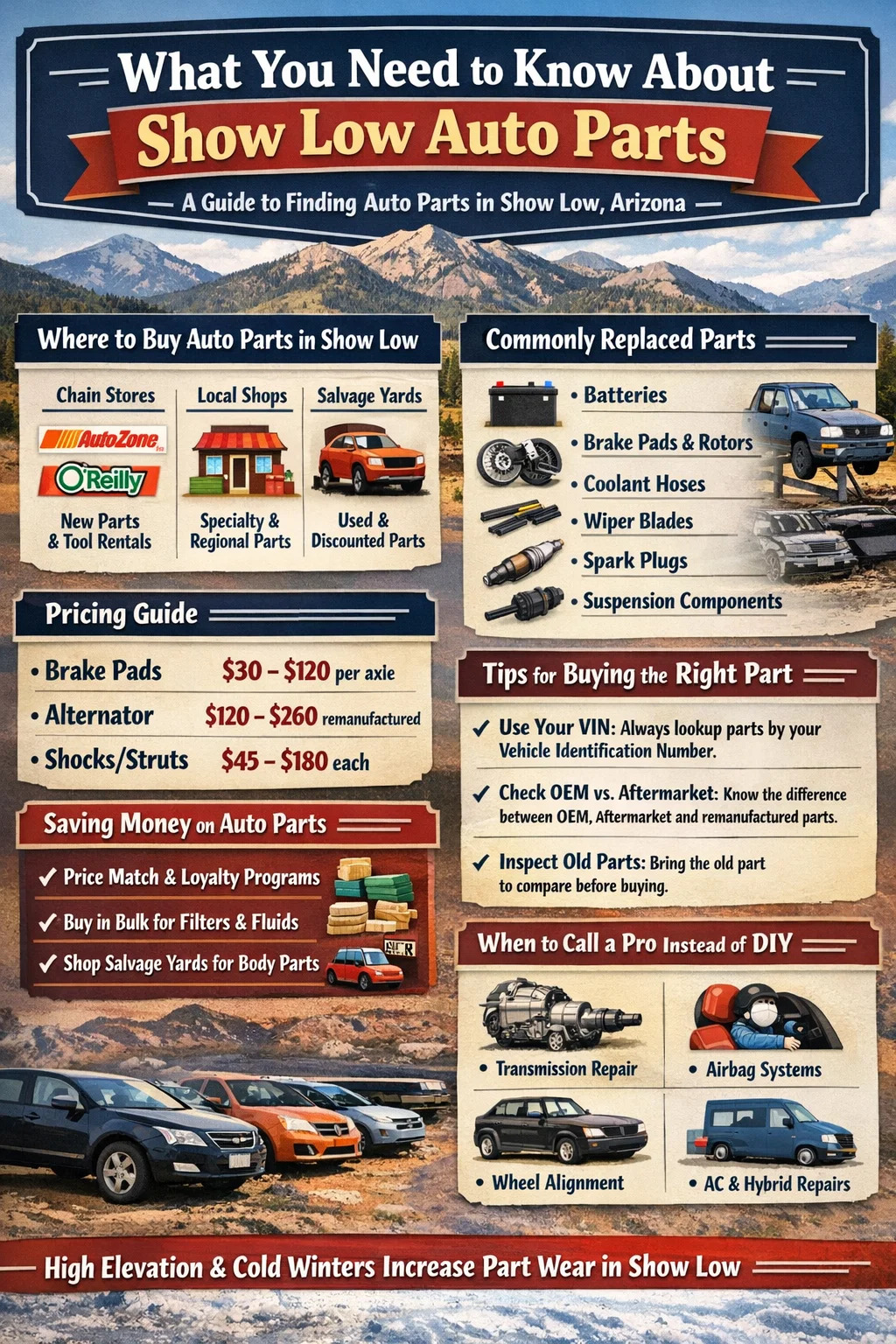
If you are looking for automobile parts in Show Low, Arizona, you have several reliable options available — from national chain stores with same-day inventory to local salvage yards offering used parts at a fraction of the retail price. The key is knowing which source fits your repair job, your vehicle make and model, and your budget before you walk in or place an order.
Show Low sits in Navajo County at an elevation of about 6,300 feet, and the mountain climate puts specific wear demands on vehicles that drivers in Phoenix or Tucson simply do not face. Cold starts, road salt during winter storms, and UV exposure at high altitude all accelerate part degradation, particularly for rubber components, batteries, and brake systems. That means residents here replace certain automobile parts more frequently than the national average.
This article walks through where to buy auto parts in Show Low, how to evaluate quality, what things typically cost, and how to avoid the most common purchasing mistakes locals make.
Where to Buy Auto Parts in Show Low, Arizona
Show Low is not a major metro area, but it has enough supply options to handle most repair needs without waiting days for shipping. Understanding the difference between these outlets helps you make faster, smarter decisions when your vehicle is down.
National Chain Auto Parts Stores
AutoZone and O'Reilly Auto Parts both have locations in or near the Show Low area. These stores carry a broad range of new automobile parts including filters, belts, hoses, brake pads, rotors, batteries, starters, and alternators. Their inventory management systems allow store staff to tell you instantly whether a specific part is in stock or needs to be ordered from a regional distribution center.
One practical advantage of national chains is the free loaner tool program. If you need a ball joint press, a spring compressor, or a brake caliper wind-back tool, many of these stores will loan the tool at no charge when you leave a deposit. For a DIY repair in Show Low where the nearest professional shop might have a multi-day wait, this can save significant time and labor cost.
Expect to pay retail prices ranging from about $8 for a basic oil filter to $280 or more for a mid-range alternator depending on your vehicle. Rewards programs at both AutoZone and O'Reilly can bring those prices down over time if you are a frequent buyer.
Local and Independent Parts Suppliers
Smaller independent auto parts stores sometimes operate in rural Arizona communities. These shops frequently carry specialty items that chain stores do not stock — including parts for older trucks, off-road vehicles, and equipment used in the surrounding White Mountains region. The staff at independent suppliers often have deeper regional knowledge and can identify parts by description when you do not have the exact part number.
Prices at independent stores vary. Some match chain pricing; others charge a small premium for niche parts but save you from waiting two to five days for a special order. For time-sensitive repairs, that tradeoff is frequently worth it.
Salvage Yards and Used Automobile Parts
Used auto parts sourced from salvage yards represent one of the best cost-reduction strategies available to Show Low vehicle owners. A used door mirror assembly that retails for $120 new might cost $30 to $50 pulled from a salvage yard. Engines and transmissions — which can run $2,000 to $5,000 new or remanufactured — are frequently available used for $400 to $1,200 depending on mileage and condition.
The Pinetop-Lakeside and Show Low corridor has salvage operations within driving distance, and online platforms like Car-Part.com aggregate inventory from hundreds of Arizona and regional junkyards. You can search by part, vehicle year, make, and model, then call the yard directly to confirm availability and arrange pickup or shipping.
When buying used automobile parts, always ask about the mileage on the donor vehicle, request photos if purchasing remotely, and confirm whether the yard offers any return window — usually 30 to 90 days for most parts.
Online Retailers Shipping to Show Low
Amazon, RockAuto, and Advance Auto Parts' online store all ship automobile parts to Show Low with standard delivery times of two to five business days. RockAuto in particular is known for aggressive pricing — often 30 to 60 percent below chain store prices on the same brand — and it lists multiple quality tiers for most parts so you can choose economy, standard, or OEM-equivalent options.
The limitation with online ordering is the wait time. If your truck needs a water pump replaced and it is mid-January in the White Mountains, waiting four days for delivery may not be practical. Online ordering works best for planned maintenance, non-urgent repairs, or when you are restoring a vehicle over weeks or months.
Most Commonly Replaced Auto Parts in Show Low's Climate
The White Mountains environment is genuinely hard on vehicles. Show Low averages around 24 inches of precipitation annually, including significant winter snowfall. Temperatures can drop below 10°F in winter and climb into the mid-90s during summer afternoons. This temperature swing, combined with road conditions and elevation-related engine demands, results in predictable wear patterns.
| Automobile Part | Why It Wears Faster in Show Low | Average Replacement Cost (Parts Only) |
|---|---|---|
| Battery | Cold temperatures reduce cranking amps; heat accelerates internal corrosion | $110 – $220 |
| Brake Pads and Rotors | Mountain grade descents increase brake load significantly | $80 – $250 per axle |
| Coolant Hoses | UV at altitude and freeze-thaw cycling crack rubber faster | $15 – $60 each |
| Wiper Blades | Snow and ice season demands; UV degrades rubber year-round | $18 – $45 per blade |
| Spark Plugs | Engines work harder at 6,300 ft elevation due to reduced oxygen | $8 – $25 each |
| Oxygen Sensors | Altitude affects air-fuel ratios, increasing sensor workload | $30 – $100 each |
| Suspension Components | Unpaved forest roads and uneven terrain common in the region | $50 – $300 per component |
Batteries deserve particular attention. At high elevation in cold weather, a battery that tests at 60 percent health in October may not start your vehicle in January. Most automotive professionals recommend replacing any battery older than four years before winter in mountain climates, regardless of whether it is showing symptoms yet.
How to Identify the Right Automobile Part for Your Vehicle
Ordering or purchasing the wrong automobile part is one of the most frustrating and expensive mistakes in DIY vehicle repair. It wastes time, often wastes a return shipping fee, and can delay a repair by days. Getting the right part the first time requires a small amount of preparation.
Use Your VIN, Not Just the Year, Make, and Model
Your Vehicle Identification Number (VIN) is a 17-character code typically located on the driver-side dashboard near the windshield or on the driver-side door jamb. It encodes your vehicle's specific production details — engine size, transmission type, trim level, production plant, and more. Two trucks with the same year, make, and model can require completely different parts if one has a 5.0L engine and the other a 3.5L, or if one was built in the first half of the production year and the other in the second half.
All major auto parts lookup tools — both at chain stores and on websites like RockAuto and AutoZone — allow VIN lookup. Use it every time for parts where fitment variations exist, including brakes, sensors, gaskets, timing components, and electrical parts.
Understand OEM vs. Aftermarket vs. Remanufactured
These three categories of automobile parts differ in origin, quality range, and price:
- OEM (Original Equipment Manufacturer) parts are made by or for your vehicle's manufacturer. They are designed to exact factory specifications. They are also the most expensive option — often 40 to 100 percent higher than aftermarket equivalents.
- Aftermarket parts are manufactured by third-party companies. Quality varies enormously. A Bosch oxygen sensor is an aftermarket part with an excellent reliability record. A no-name catalytic converter from an unknown overseas supplier may fail within a year. Brand research matters here.
- Remanufactured parts are used cores that have been rebuilt to a functional standard — common for alternators, starters, steering racks, and calipers. Most come with a warranty and cost 30 to 60 percent less than new OEM parts.
For most daily-driver repairs in Show Low, a quality aftermarket or remanufactured automobile part is the right balance of cost and reliability. Save OEM for critical safety components or vehicles still under warranty where non-OEM parts could complicate warranty claims.
Pull the Old Part Before Ordering When Possible
For parts that are straightforward to remove — filters, sensors, belts — pull the old part first and bring it with you to the store or photograph it for online comparison. Look for stamped part numbers, manufacturer codes, and dimensional markings. This removes any ambiguity about fitment and prevents buying a part with the right catalog listing but slightly different thread pitch or connector type.
Pricing Guide: What to Expect to Pay for Common Auto Parts in Show Low
Prices for automobile parts in Show Low generally mirror national retail but can run slightly higher at local stores due to lower volume purchasing and transportation costs to a rural mountain location. Below are realistic price ranges for frequently needed parts across multiple vehicle categories.
Engine and Drivetrain Parts
- Oil filter: $6 – $18 (budget to premium synthetic)
- Air filter: $12 – $35
- Fuel filter: $15 – $60 depending on whether it is inline or in-tank
- Timing belt kit (with tensioner and water pump): $80 – $220
- Serpentine belt: $25 – $65
- Water pump: $40 – $130
- Thermostat: $10 – $40
- Starter (remanufactured): $90 – $180
- Alternator (remanufactured): $120 – $260
Brake System Components
- Brake pads (per axle): $30 – $120 depending on vehicle and pad compound
- Brake rotors (each): $35 – $110
- Brake caliper (remanufactured): $45 – $130 each
- Brake master cylinder: $60 – $150
- Brake fluid (32 oz): $10 – $20
Suspension and Steering Parts
- Shocks or struts (each): $45 – $180
- Ball joint: $30 – $110
- Tie rod end: $25 – $80
- Control arm: $60 – $200
- Sway bar end link: $15 – $50
For truck owners — and trucks represent a significant portion of Show Low's vehicle population — expect to pay 20 to 40 percent more on average for parts compared to a compact sedan, particularly for brake components, filters, and drivetrain parts due to the larger size and heavier-duty specifications.
Evaluating Part Quality Before You Buy
Not all automobile parts on the shelf are created equal, and the consequences of buying a low-quality part in a rural area like Show Low can be more severe than in a city where you can quickly get a replacement or reach a shop. A failed caliper on a mountain grade is a safety issue, not just an inconvenience.
Reputable Aftermarket Brands by Category
The aftermarket automobile parts industry has a clear quality hierarchy that is worth knowing before purchase:
- Brakes: Akebono, EBC, Bosch QuietCast, Wagner ThermoQuiet, and Raybestos are well-regarded for pads. Brembo and StopTech for rotors on performance or heavy-duty applications.
- Filters: WIX, Purolator, Bosch, and K&N have strong performance and filtration records. Avoid unbranded or unknown-origin filters.
- Sensors: Bosch, Denso, Delphi, and NTK are the standard for oxygen sensors, MAF sensors, and crankshaft position sensors.
- Suspension: Monroe, KYB, and Bilstein are reliable for shocks and struts. Moog is widely trusted for ball joints and steering linkage components.
- Electrical: ACDelco, Motorcraft, and Denso produce reliable starters and alternators. Be cautious with off-brand electrical components — failure rates are substantially higher.
Check the Warranty Terms
Warranty coverage on automobile parts ranges from 90-day guarantees on economy parts to lifetime warranties on brake pads, certain filters, and some electrical components. Before buying, confirm what the warranty covers — defects only, or also labor? Is it nationwide or only at the original purchase location? A part with a lifetime warranty from a national chain can be replaced at any of their hundreds of locations, which matters if your vehicle breaks down away from Show Low.
Read Reviews for Specific Part Numbers
Databases like RockAuto, Amazon, and FCP Euro display customer reviews at the specific part-number level, not just the brand level. A brand that makes excellent oil filters may produce mediocre water pumps. Search the specific part number plus "review" or "failure rate" before committing to a purchase over $50. Online forums for your specific vehicle model — particularly for trucks and Jeeps common in the Show Low area — often have consensus recommendations based on real owner experience in similar climates and terrain conditions.
Saving Money on Auto Parts Without Sacrificing Reliability
Automobile parts represent a significant household expense for anyone who drives regularly in a demanding environment. There are legitimate ways to reduce that cost without buying unreliable components.
Price Match and Loyalty Programs
AutoZone and O'Reilly both operate loyalty reward programs that return cash value on purchases. O'Reilly's program gives $5 back for every $75 spent, which adds up meaningfully for someone doing multiple repairs per year. AutoZone Rewards operates similarly. Both stores also participate in price-matching under certain conditions — if you find the same part number cheaper at a competitor, ask about a price match before checkout.
Buy Filters and Wear Items in Bulk
If you own a vehicle you plan to keep for five or more years, buying oil filters, air filters, and cabin air filters in multi-pack quantities from Amazon or RockAuto often saves 25 to 40 percent over buying one at a time from a retail store. These parts do not go bad sitting on a shelf. For a truck owner doing oil changes every 5,000 miles, that is two filters per year — buying six at once makes clear financial sense.
Prioritize Used Parts for Body and Interior Components
Mechanical parts under the hood benefit from being new or remanufactured, but body panels, mirrors, handles, interior trim, glass, and lighting assemblies are excellent candidates for used sourcing. A used tail light assembly from a salvage yard typically costs 70 to 80 percent less than a new OEM or aftermarket replacement, and for body components not subject to internal wear, used condition is entirely acceptable as long as the part is undamaged.
Time Purchases Around Sales
Both national chain stores run promotional sales tied to holidays — Memorial Day, Labor Day, and Black Friday typically bring 20 to 30 percent discounts on select parts and fluids. If a repair is not urgent, planning a purchase around one of these sales windows for more expensive components like shocks, brakes, or batteries can deliver meaningful savings. Sign up for email lists from AutoZone, O'Reilly, and RockAuto to receive sale notifications.
When to Call a Professional Instead of DIYing in Show Low
Show Low has a smaller concentration of auto repair shops than a city, which means wait times can be longer and costs can be higher than in urban Arizona. This pushes many vehicle owners toward DIY repairs, which is reasonable for many jobs. But some automobile part replacements genuinely require professional equipment, experience, or both.
Jobs That Warrant Professional Help
- Airbag components: Steering wheels, clock springs, and airbag modules involve explosive devices. DIY errors can result in accidental deployment, which causes serious injury. Always have a professional handle these.
- Transmission overhaul or replacement: Even for experienced home mechanics, a transmission requires a lift, specialized tools, and a significant time investment. The risk of a botched installation on a transmission is very high.
- Wheel alignment: After any suspension work, alignment must be checked with a computerized alignment rack. There is no way to do this correctly without the equipment. Misalignment causes tire wear and handling problems that develop gradually — you may not notice immediately but will pay for it.
- AC system recharge and repair: Working with refrigerant requires EPA certification and specialized recovery equipment. Venting refrigerant to the atmosphere is illegal.
- High-voltage components in hybrid or EV vehicles: Battery packs and inverters in hybrid and electric vehicles operate at voltages that can be lethal. These require specific training and insulated tools.
For these jobs, sourcing the automobile part yourself and providing it to a shop is still a legitimate cost-saving strategy. Many shops will install customer-supplied parts — confirm this policy before proceeding, as some shops decline for liability reasons or charge a higher labor rate for non-shop-supplied parts.
Tips for Off-Road and Truck Owners in the Show Low Area
The White Mountains region draws a large population of truck and SUV owners who use forest roads, hunting access roads, and unpaved routes regularly. This off-road use pattern creates part wear that differs substantially from highway driving, and sourcing appropriate parts is not always as straightforward as standard replacement.
Heavy-Duty Upgrade Parts Worth Considering
For vehicles that regularly go off-road or tow heavy loads in the mountains, stock replacement parts are not always the best choice. Upgraded alternatives often cost only slightly more and last significantly longer under demanding use:
- Bilstein 5100 series shocks over stock replacements for trucks that go off-road — the difference in durability and handling on rough terrain is measurable.
- Upgraded brake pads with higher thermal limits for towing on grades — standard pads can fade significantly on long descents with a loaded trailer.
- Reinforced CV axle assemblies for lifted trucks — stock axles are designed for stock ride height, and a lift places additional stress on the CV joints that leads to premature failure.
- Skid plates and differential covers — not replacement parts in the traditional sense, but protective components that prevent you from needing replacement parts after rock strikes.
Sourcing Specialty Off-Road Parts
National chain stores in Show Low stock standard replacement automobile parts but typically carry limited off-road upgrade inventory. For Jeep, Toyota, and Ford truck owners seeking performance upgrades, online retailers like 4WheelParts, Quadratec (for Jeep), and Summit Racing offer broader selection and ship to the Show Low area. Many of these retailers have vehicle-specific catalogs and customer service staff who can advise on fitment for lifted or modified vehicles.
Avoiding the Most Common Auto Parts Mistakes in Show Low
Residents in rural areas like Show Low face a compounded risk when they purchase the wrong part or a low-quality part — the nearest alternative supplier may be 45 minutes away, and professional shop wait times can stretch to days during busy seasons. These mistakes are entirely avoidable.
- Buying by year/make/model alone without checking sub-model or engine code. A 2018 Ram 1500 comes with four different engine options, each requiring different spark plugs, filters, and tune-up components. Always verify the engine displacement and sub-trim before ordering.
- Replacing only one side of a paired component. Brake pads, rotors, shocks, and struts should always be replaced in axle pairs. Replacing only one side creates imbalanced braking or handling that can be dangerous on mountain roads.
- Skipping the core return on remanufactured parts. When you buy a remanufactured starter, alternator, or caliper, the price includes a core charge that is refunded when you return the old part. Forgetting to return the core costs you $15 to $60 unnecessarily.
- Assuming the cheapest option on the shelf is the same as mid-range. Economy-tier parts at chain stores are frequently manufactured to lower tolerances. For critical components, spending $20 to $40 more for a name-brand part reduces the probability of repeat failure significantly.
- Neglecting related components during a major repair. If you are replacing a timing belt, replace the tensioner, idler pulley, and water pump at the same time — the labor is already done. Failing to do so often results in returning to the same job within 12 months when the adjacent parts fail.
- Not verifying fitment on used parts before full purchase. Always confirm that a used automobile part fits your specific vehicle before completing a salvage yard transaction. Bring the old part for direct comparison when possible.