 English
 Español
Content
- 1 What Are the Main Parts of a Car and What Do They Do
- 2 The Engine: The Heart of Every Automobile
- 3 Transmission: Controlling Power Delivery
- 4 Braking System: Every Component That Stops Your Car
- 5 Suspension System: Ride Quality and Road Contact
- 6 Steering System Parts and How They Work Together
- 7 Drivetrain Components: Getting Power to the Wheels
- 8 Fuel System Parts: Delivering Energy to the Engine
- 9 Exhaust System: Managing Emissions and Engine Efficiency
- 10 Electrical System: The Network That Controls Everything
- 11 Body and Chassis Parts: Structure, Safety, and Aerodynamics
- 12 HVAC System: Climate Control Components
- 13 Wheels, Tires, and Wheel Bearings
- 14 Common Automobile Part Failures and What They Cost to Fix
- 15 How Understanding Automobile Parts Helps You Maintain Your Vehicle
What Are the Main Parts of a Car and What Do They Do
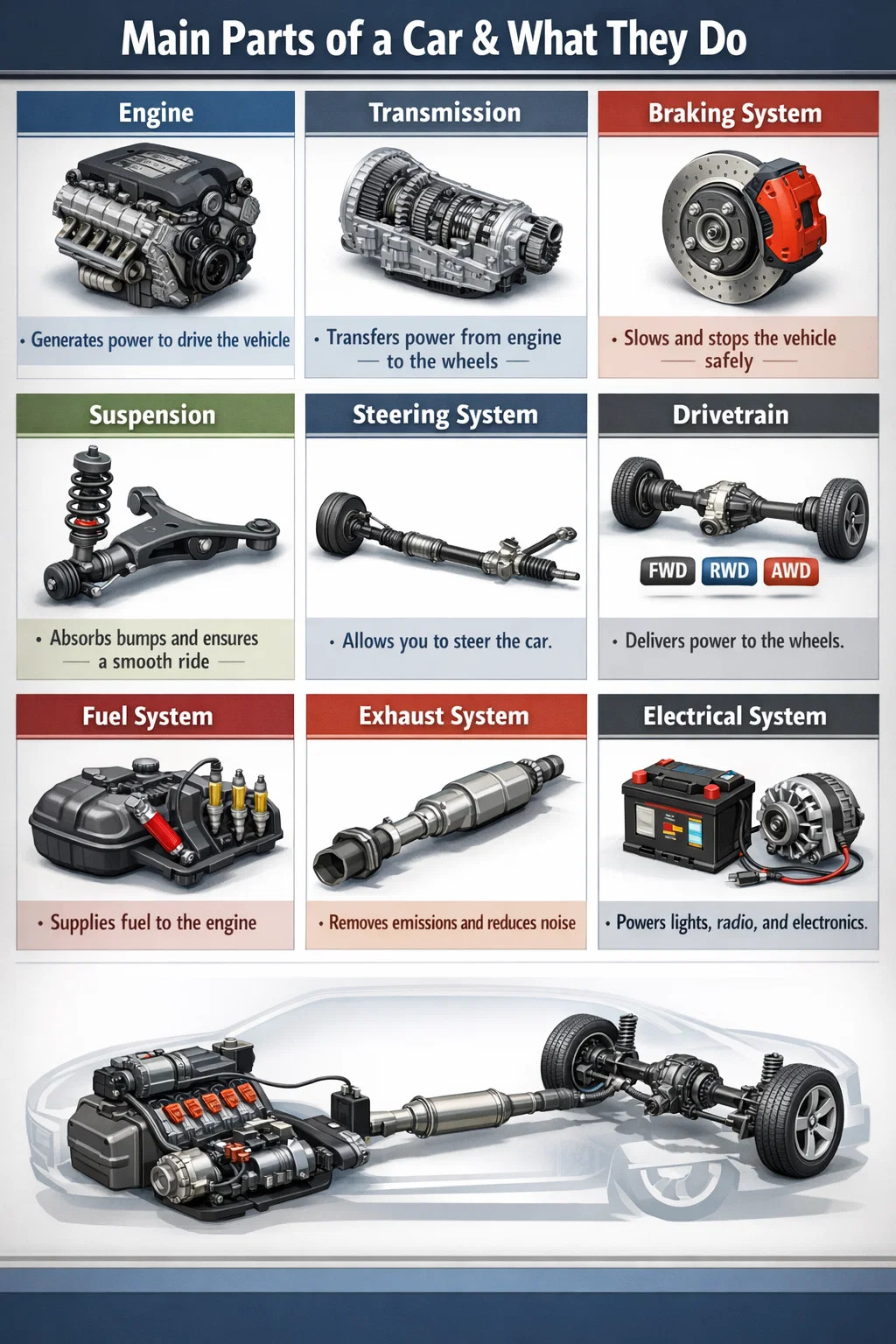
Every vehicle on the road is made up of thousands of individual components, but most of the mechanical work is handled by a relatively small group of major systems. The core automobile parts include the engine, transmission, suspension, braking system, steering system, fuel system, electrical system, exhaust system, and the drivetrain. Each one has a specific job, and when any single part fails, it can compromise the entire vehicle's performance or safety.
Understanding parts of cars and what they do is not just for mechanics. It helps everyday drivers recognize warning signs earlier, make smarter repair decisions, avoid being overcharged at the shop, and extend the lifespan of their vehicles. A well-maintained car can exceed 200,000 miles — but only if its components are understood and treated correctly.
Below is a thorough breakdown of every major automobile part, what it does, how it works, and why it matters.
The Engine: The Heart of Every Automobile
The internal combustion engine is the most complex and critical automobile part in a conventional vehicle. It converts fuel into mechanical energy through a process called combustion. Most passenger car engines are four-cylinder or six-cylinder units, though performance vehicles often use eight cylinders or more.
Inside the engine, several essential components work together in a continuous cycle:
- Pistons: These move up and down inside the cylinders, compressing the air-fuel mixture and transferring combustion force to the crankshaft. A typical piston travels at speeds exceeding 1,500 feet per minute during normal highway driving.
- Crankshaft: Converts the pistons' up-and-down motion into the rotational motion that ultimately drives the wheels. It is one of the most precisely machined automobile parts in any engine.
- Camshaft: Controls the timing of the intake and exhaust valves. Variable valve timing systems, found in most modern engines, use the camshaft's position to optimize performance and fuel economy at different RPM ranges.
- Connecting Rods: Link each piston to the crankshaft, transmitting force between the two components thousands of times per minute.
- Cylinder Head: Sits on top of the engine block and houses the valves, spark plugs, and in many cases, the camshaft. It forms the upper boundary of each combustion chamber.
- Timing Belt or Chain: Keeps the crankshaft and camshaft synchronized. A broken timing belt can cause catastrophic engine damage in interference engines. Most manufacturers recommend replacement every 60,000 to 100,000 miles.
- Oil Pan and Lubrication System: Store and circulate engine oil to reduce friction between moving parts. Without proper lubrication, engine components can seize within minutes.
The engine block itself is typically cast from aluminum or iron and forms the structural foundation for all internal components. Modern engines also include a head gasket between the block and cylinder head — a seemingly simple automobile part that, when it fails, can allow coolant and oil to mix, leading to severe and expensive damage.
Engine Cooling System Components
Because combustion generates enormous heat — temperatures inside a cylinder can exceed 4,500°F at peak — the engine requires a dedicated cooling system. Key parts include the radiator, water pump, thermostat, coolant reservoir, and a series of hoses and clamps. The radiator alone can hold anywhere from one to two gallons of coolant mixture. The water pump circulates this coolant through passages in the engine block and cylinder head, absorbing heat and releasing it through the radiator.
The thermostat regulates coolant flow based on temperature — it stays closed when the engine is cold to help it warm up faster, then opens to allow full coolant circulation once operating temperature (typically around 195°F to 220°F) is reached.
Transmission: Controlling Power Delivery
The transmission is the automobile part responsible for taking the engine's power output and transferring it to the drivetrain at the correct ratio for driving conditions. Without a transmission, engines could only operate efficiently within a narrow speed range, making city driving, highway cruising, and climbing hills impractical with a single gear ratio.
There are three main types of transmissions found in modern vehicles:
- Manual Transmission: Uses a clutch pedal and gear lever to allow the driver to select gears manually. The clutch disk, pressure plate, and flywheel are the key automobile parts involved in this process. Manual transmissions typically have five to six forward gears and offer better fuel economy in the hands of a skilled driver.
- Automatic Transmission: Uses a torque converter and a planetary gear set to shift gears without driver input. Modern automatics may have six, eight, or even ten speeds. The 10-speed automatic found in some Ford F-150 and Chevrolet Camaro models delivers smoother acceleration and better fuel efficiency than older six-speed units.
- CVT (Continuously Variable Transmission): Uses a belt and pulley system to provide an infinite range of gear ratios without distinct shifts. Common in fuel-efficient compact cars like the Honda Civic CVT and Toyota Corolla, they prioritize economy over driving feel.
Internal transmission components include gear sets, bands, clutch packs, solenoids, and the valve body — all submerged in transmission fluid that must be changed periodically. Most manufacturers recommend automatic transmission fluid changes every 30,000 to 60,000 miles, though many drivers skip this service until problems develop, which can result in rebuild costs of $1,500 to $3,500 or more.
Braking System: Every Component That Stops Your Car
The braking system is arguably the most safety-critical set of automobile parts on any vehicle. It converts kinetic energy into heat through friction, slowing or stopping the car. A properly functioning braking system should bring a vehicle traveling at 60 mph to a complete stop in approximately 130 to 140 feet under normal conditions — though this varies by vehicle weight, tire condition, and brake health.
Disc Brakes
Disc brakes are used on the front axle of virtually all modern passenger cars and on the rear axle of most new vehicles as well. The main automobile parts in a disc brake system are:
- Brake Rotor: A flat metal disc that rotates with the wheel. When brakes are applied, the caliper squeezes brake pads against the rotor to create friction. Rotors typically last 50,000 to 70,000 miles but may warp if overheated repeatedly.
- Brake Caliper: A hydraulic clamp that holds the brake pads and squeezes them against the rotor when the brake pedal is pressed. Calipers can seize if not properly maintained, causing uneven pad wear and reduced stopping power.
- Brake Pads: The friction material that contacts the rotor. Pad thickness should remain above 3mm for safe operation; most new pads measure around 10 to 12mm. Worn pads create the familiar squealing or grinding sound that signals immediate replacement is needed.
Drum Brakes and Hydraulic Components
Drum brakes are still common on the rear axles of economy cars. They use curved brake shoes that press outward against the inside of a rotating drum. While less efficient than disc brakes at high-speed stops, drums work adequately for rear axle braking where force demands are lower.
Hydraulic components are the backbone of the system. The brake master cylinder converts pedal force into hydraulic pressure, sending fluid through steel brake lines and flexible hoses to each caliper or wheel cylinder. The brake booster — typically vacuum-assisted — multiplies pedal force so drivers don't need to push hard to generate strong braking. ABS (Anti-lock Braking System) modulators add electronic control, pulsing brake pressure up to 15 times per second to prevent wheel lockup during emergency stops.
Suspension System: Ride Quality and Road Contact
The suspension system connects the car body to its wheels, absorbs road imperfections, and keeps the tires in firm contact with the road surface. It is a collection of automobile parts that work together to balance ride comfort with handling precision.
Primary suspension components include:
- Shock Absorbers (Dampers): Control the rate at which the suspension compresses and rebounds after hitting a bump. A worn shock absorber can increase stopping distance by up to 20% and significantly reduce cornering stability. Most require replacement every 50,000 miles.
- Coil Springs: Support the vehicle's weight and absorb initial impact energy. Spring rate (measured in pounds per inch) determines how stiff or soft the ride feels — stiffer springs improve handling, while softer springs prioritize comfort.
- Struts: A combined structural unit that integrates the coil spring and shock absorber into a single automobile part. MacPherson struts, the most common design on front-wheel-drive vehicles, also serve as the upper support for the steering knuckle.
- Control Arms: Link the wheel hub assembly to the vehicle's frame, allowing vertical movement while maintaining wheel alignment. Upper and lower control arms work together in double-wishbone suspension systems.
- Ball Joints: Pivot points that allow the control arm and steering knuckle to move in multiple directions simultaneously. Worn ball joints are a serious safety issue — failure can cause a wheel to collapse under the vehicle.
- Sway Bar (Stabilizer Bar): A U-shaped steel rod that connects the left and right suspension on the same axle. It resists body roll during cornering by transferring force from one side to the other, keeping the vehicle flatter through turns.
- Bushings: Rubber or polyurethane sleeves that cushion the connections between metal suspension components. They wear out gradually and are responsible for clunking or knocking sounds from the suspension.
Steering System Parts and How They Work Together
The steering system translates input from the steering wheel into directional changes at the front wheels. Modern vehicles almost universally use rack-and-pinion steering, which is more precise and compact than the older recirculating ball design used in trucks and older American cars.
Key steering automobile parts include:
- Steering Rack: A metal bar with a gear at its center that meshes with the pinion gear on the steering column. As the wheel turns, the rack slides left or right, pushing or pulling the tie rods connected to the front wheels.
- Tie Rods: Connect the steering rack to the steering knuckle at each front wheel. Inner and outer tie rod ends are separate automobile parts — the outer tie rod end is a common wear item that affects steering precision and wheel alignment.
- Steering Column: The shaft connecting the steering wheel to the rack. It typically includes a collapsible section designed to compress in a frontal collision rather than impaling the driver.
- Power Steering Pump or Electric Motor: Hydraulic power steering uses a belt-driven pump to pressurize steering fluid, while electric power steering (EPS) uses an electric motor mounted on the rack or column. EPS is now standard on most new vehicles because it eliminates the power steering pump and its fluid, reducing maintenance and improving fuel economy by an estimated 1 to 3 mpg.
Drivetrain Components: Getting Power to the Wheels
The drivetrain refers to the group of automobile parts that transfer power from the transmission output to the driven wheels. The specific components vary based on whether the vehicle is front-wheel drive (FWD), rear-wheel drive (RWD), all-wheel drive (AWD), or four-wheel drive (4WD).
| Drivetrain Type | Driven Wheels | Key Components | Common Applications |
|---|---|---|---|
| FWD | Front | CV axles, transaxle | Compact cars, sedans |
| RWD | Rear | Driveshaft, rear differential, axle shafts | Sports cars, trucks, luxury sedans |
| AWD | All four | Front/rear differentials, transfer case, CV axles | SUVs, crossovers |
| 4WD | All four (selectable) | Transfer case, locking differentials, solid axles | Off-road trucks, body-on-frame SUVs |
CV (Constant Velocity) joints and axles are among the most frequently replaced drivetrain automobile parts on front-wheel-drive vehicles. They allow the axle to transmit power through the full range of suspension and steering motion. A torn CV boot — the rubber cover protecting the joint's grease — is a cheap fix (around $150 to $200) if caught early, but a neglected joint will eventually fail and require complete axle replacement at $300 to $600 or more.
The differential is a gear assembly that allows the left and right driven wheels to rotate at different speeds — critical when cornering, because the outside wheel travels a longer path than the inside wheel. Without a differential, tires would scrub and skip through every turn.
Fuel System Parts: Delivering Energy to the Engine
The fuel system manages the storage, filtration, and delivery of fuel to the engine's combustion chambers. Every component must function correctly — inadequate fuel pressure or contaminated fuel will cause rough running, misfires, or no-start conditions.
- Fuel Tank: Stores gasoline or diesel fuel. Modern fuel tanks are made from high-density polyethylene (HDPE) and are shaped to fit efficiently within the vehicle's chassis. A full tank in a typical midsize sedan holds between 13 and 18 gallons.
- Fuel Pump: Most modern vehicles use an electric fuel pump mounted inside the fuel tank. It draws fuel and pushes it through the fuel lines at pressures ranging from 30 to 80 psi depending on the injection system. Fuel pump failure results in the engine cranking but not starting.
- Fuel Filter: Removes particulates and debris from the fuel before it reaches the injectors. Some filters are inline (replaceable every 30,000 miles), while others are integrated into the fuel pump module inside the tank.
- Fuel Injectors: Electronically controlled valves that spray precise amounts of atomized fuel directly into the intake port or combustion chamber. Port injection sprays into the intake manifold, while direct injection (GDI) sprays into the cylinder itself — enabling better fuel economy and higher compression ratios, though GDI systems are more prone to carbon buildup on intake valves.
- Fuel Pressure Regulator: Maintains consistent fuel pressure at the injectors regardless of engine demand. A failed regulator causes rich or lean running conditions that trigger the check engine light.
Exhaust System: Managing Emissions and Engine Efficiency
After combustion occurs, the exhaust system collects and routes burned gases out of the engine, reduces harmful emissions, and quiets engine noise. A complete exhaust system includes several distinct automobile parts:
- Exhaust Manifold: Bolted directly to the cylinder head, it collects exhaust gases from each cylinder and channels them into a single pipe. Cracked manifolds cause exhaust leaks that produce a ticking sound and can allow carbon monoxide to enter the cabin.
- Catalytic Converter: Uses precious metals (platinum, palladium, and rhodium) to convert toxic exhaust gases — carbon monoxide, hydrocarbons, and nitrogen oxides — into less harmful water vapor and carbon dioxide. Catalytic converters are one of the most valuable automobile parts by weight, which is why they are frequently targeted by thieves. Replacement costs range from $500 to over $3,000 for premium vehicles.
- Oxygen Sensors (O2 Sensors): Monitor the oxygen content of exhaust gases before and after the catalytic converter. The engine control module uses this data to fine-tune the air-fuel mixture in real time. A failed O2 sensor typically increases fuel consumption by 10 to 40%.
- Muffler: Uses chambers and baffles to cancel out sound pressure waves from the exhaust. A rusted or damaged muffler dramatically increases exhaust noise and may allow exhaust gases to leak before they exit the tailpipe.
- Exhaust Pipes: Connect all exhaust components from manifold to tailpipe. Flex pipes (corrugated sections) absorb vibration between the engine and fixed chassis components. These flex pipes are a common failure point, especially on high-mileage vehicles.
Electrical System: The Network That Controls Everything
Modern vehicles are as much electronic as they are mechanical. The electrical system powers everything from the starter motor to the entertainment system, and failures in this network can disable the entire vehicle or create unpredictable behavior.
Battery and Charging System
The 12-volt lead-acid battery provides current to start the engine and powers accessories when the engine is off. Most car batteries have a lifespan of three to five years. The alternator charges the battery while the engine runs, generating alternating current that a voltage regulator converts to a stable 13.5 to 14.5 volts DC. A failing alternator will drain the battery even while driving, eventually leaving the vehicle stranded.
Starter Motor and Ignition System
The starter motor is a high-torque electric motor that cranks the engine to initiate combustion. It draws enormous current — typically 100 to 200 amps during cranking. The ignition system then takes over, using the ignition coil (or coil-on-plug assemblies in modern engines) to generate the 20,000 to 45,000 volts needed to fire the spark plugs.
Spark plugs ignite the compressed air-fuel mixture in each cylinder. Iridium and platinum spark plugs — common in modern engines — can last 60,000 to 100,000 miles, compared to the 15,000 to 30,000 mile lifespan of older copper plugs.
Sensors and Engine Control Module
The engine control module (ECM) is the central computer that manages engine operation. It receives data from dozens of sensors — mass airflow sensor, throttle position sensor, crankshaft position sensor, coolant temperature sensor, knock sensor, and more — and uses this information to precisely control fuel injection timing, ignition timing, idle speed, and emission controls. A modern premium vehicle can contain over 100 electronic control units managing everything from the engine to the adaptive cruise control.
Body and Chassis Parts: Structure, Safety, and Aerodynamics
The body and chassis form the structural skeleton of the vehicle, protecting occupants and providing mounting points for all mechanical systems. Modern unibody construction integrates the body and frame into a single structure, which is lighter and more rigid than traditional body-on-frame designs while also providing controlled crumple zones in a collision.
- Crumple Zones: Engineered sections at the front and rear designed to fold and absorb collision energy, protecting the passenger compartment. NHTSA crash test data consistently shows that vehicles with well-designed crumple zones significantly reduce injury severity in frontal impacts.
- Subframe: A partial frame attached to the unibody that provides rigid mounting points for the engine, transmission, and front suspension. It also isolates vibration from the passenger compartment.
- Doors, Hood, and Trunk Lid: Stamped steel or aluminum panels that form the outer skin. Modern hoods often include pedestrian protection features — engineered to deform upon impact to reduce head injury severity.
- Windshield and Glass: The windshield is laminated safety glass — two layers of glass bonded to a plastic PVB interlayer — that holds together when broken. Side and rear windows use tempered glass that shatters into small, rounded granules rather than sharp shards.
- Airbags: Pyrotechnic safety devices that inflate in milliseconds during a collision. A modern vehicle may contain six to twelve airbags: front, side curtain, seat-mounted side, knee, and rear airbags. The airbag module includes the inflator, bag, and crash sensor — all working as a single automobile part system.
HVAC System: Climate Control Components
The heating, ventilation, and air conditioning (HVAC) system maintains interior comfort and visibility. Its main automobile parts include:
- AC Compressor: Pressurizes refrigerant and circulates it through the system. Driven by a belt from the engine, compressor failure results in warm air from the vents. Replacement typically costs $500 to $1,200 including refrigerant recharge.
- Condenser: Located in front of the radiator, it dissipates heat from the compressed refrigerant to outside air. Road debris punctures are a common cause of refrigerant leaks.
- Evaporator: Located inside the dash, it absorbs heat from cabin air, cooling it before it enters the passenger compartment. Evaporator leaks are expensive to repair because accessing this automobile part requires removing the entire dashboard.
- Heater Core: A small radiator-like heat exchanger mounted behind the dashboard through which hot engine coolant circulates to heat the cabin. A leaking heater core produces a sweet smell inside the car and fogs the windshield — and like the evaporator, requires dashboard removal to replace.
- Cabin Air Filter: Filters dust, pollen, and particulates from air entering the cabin through the HVAC system. Most manufacturers recommend replacement every 15,000 to 25,000 miles, though heavily polluted environments may require more frequent changes.
Wheels, Tires, and Wheel Bearings
Tires are the only automobile part that actually contacts the road, making them foundational to every aspect of vehicle performance — acceleration, braking, handling, and fuel economy. A tire's contact patch with the road is roughly the size of a human hand for each wheel.
Tire pressure alone has measurable effects: the U.S. Department of Energy estimates that properly inflated tires improve fuel economy by up to 3%, while underinflation by just 1 psi reduces economy by 0.2% and accelerates wear on the tire shoulders.
Wheel bearings allow the wheel to spin freely on the hub while supporting the vehicle's weight. A failing wheel bearing typically produces a droning or grinding noise that changes in pitch with vehicle speed. Ignored wheel bearing failure can eventually allow a wheel to separate from the vehicle — a catastrophic safety hazard. Replacement costs run from $150 to $400 per axle depending on whether the bearing is a standalone unit or integrated into a hub assembly.
Wheels (rims) are the metal structures that mount the tires and bolt to the hub. Alloy wheels — made from aluminum or magnesium alloys — are lighter than steel wheels, which reduces unsprung weight and improves both handling response and fuel economy. Steel wheels remain common on economy trims and spare tires due to their lower cost and resistance to bending from potholes.
Common Automobile Part Failures and What They Cost to Fix
Knowing which automobile parts fail most often — and approximately what repairs cost — helps drivers plan maintenance budgets and avoid being blindsided at the shop.
| Automobile Part | Typical Lifespan | Average Repair Cost (USD) | Warning Signs |
|---|---|---|---|
| Brake Pads | 25,000–70,000 mi | $150–$300 per axle | Squealing, grinding, longer stops |
| Battery | 3–5 years | $150–$300 | Slow cranking, warning light |
| Alternator | 80,000–150,000 mi | $400–$800 | Battery light, dimming lights |
| Shock Absorbers / Struts | 50,000–100,000 mi | $450–$900 per axle | Bouncy ride, nose dives during braking |
| Catalytic Converter | 100,000+ mi | $500–$3,000+ | Check engine light (P0420), rattling |
| Timing Belt | 60,000–100,000 mi | $400–$900 | None (preventive replacement) |
| Water Pump | 60,000–100,000 mi | $300–$750 | Coolant leak, overheating |
| CV Axle | 70,000–130,000 mi | $300–$600 per side | Clicking during turns, vibration |
How Understanding Automobile Parts Helps You Maintain Your Vehicle
Recognizing which automobile part is causing a symptom — before going to a mechanic — puts the vehicle owner in a far stronger position. Here are practical examples of how this knowledge translates into real savings and safety:
- A knocking noise from the front suspension that worsens over bumps almost always points to worn sway bar end links or control arm bushings — both inexpensive parts that mechanics sometimes bundle with unnecessary additional repairs.
- A car that pulls to one side during braking usually has a stuck brake caliper — not an alignment issue, which some shops incorrectly diagnose. Alignment only affects how the car tracks in a straight line, not brake-induced pulling.
- A check engine light with code P0171 (system too lean, bank 1) most often indicates a vacuum leak, dirty mass airflow sensor, or failing oxygen sensor — not necessarily a major engine problem. Clearing the code without diagnosis wastes money and allows the underlying issue to worsen.
- Performing your own cabin air filter replacement takes about five minutes on most vehicles and costs $10 to $20 for the part — compared to the $50 to $80 many service centers charge for the same job.
Preventive maintenance on key automobile parts consistently delivers the best return on investment. An oil change at $50 to $80 every 5,000 to 7,500 miles protects an engine that would cost $3,000 to $8,000 to replace. A $20 coolant flush every two years protects the water pump, thermostat, and radiator. These are asymmetric trades — small, predictable costs that prevent large, unexpected ones.