 English
 Español
Content
- 1 What Is an Auto Part?
- 2 The Main Categories of Auto Parts Every Car Owner Should Know
- 3 OEM vs. Aftermarket vs. Remanufactured: How to Choose the Right Auto Part
- 4 How Auto Parts Are Identified: VIN, Part Numbers, and Fitment
- 5 Most Commonly Replaced Auto Parts and Their Average Costs
- 6 Where to Buy Auto Parts: Retail, Online, and Dealer Options
- 7 Quality Indicators: How to Evaluate an Auto Part Before You Buy
- 8 Auto Parts for Electric Vehicles: What's Different
- 9 DIY vs. Professional Installation: Knowing When Each Makes Sense
- 10 Understanding Auto Part Warranties and Return Policies
- 11 The Role of Auto Parts in Vehicle Safety
What Is an Auto Part?
An auto part — also called a car part or vehicle component — is any individual piece, assembly, or system that makes up a motor vehicle. Every car, truck, or SUV is built from thousands of individual auto parts, each with a specific function that contributes to how the vehicle starts, moves, stops, steers, and keeps its occupants safe and comfortable. Without properly functioning auto parts, a vehicle cannot operate reliably or safely.
The global automotive parts market was valued at approximately $1.9 trillion in 2023 and is expected to grow steadily through the decade. This reflects just how central auto parts are to modern transportation, manufacturing, and the aftermarket repair industry. Whether you are a car owner replacing a worn brake pad, a mechanic sourcing an engine gasket, or a fleet manager ordering filters in bulk, understanding what auto parts are and how they are classified is essential knowledge.
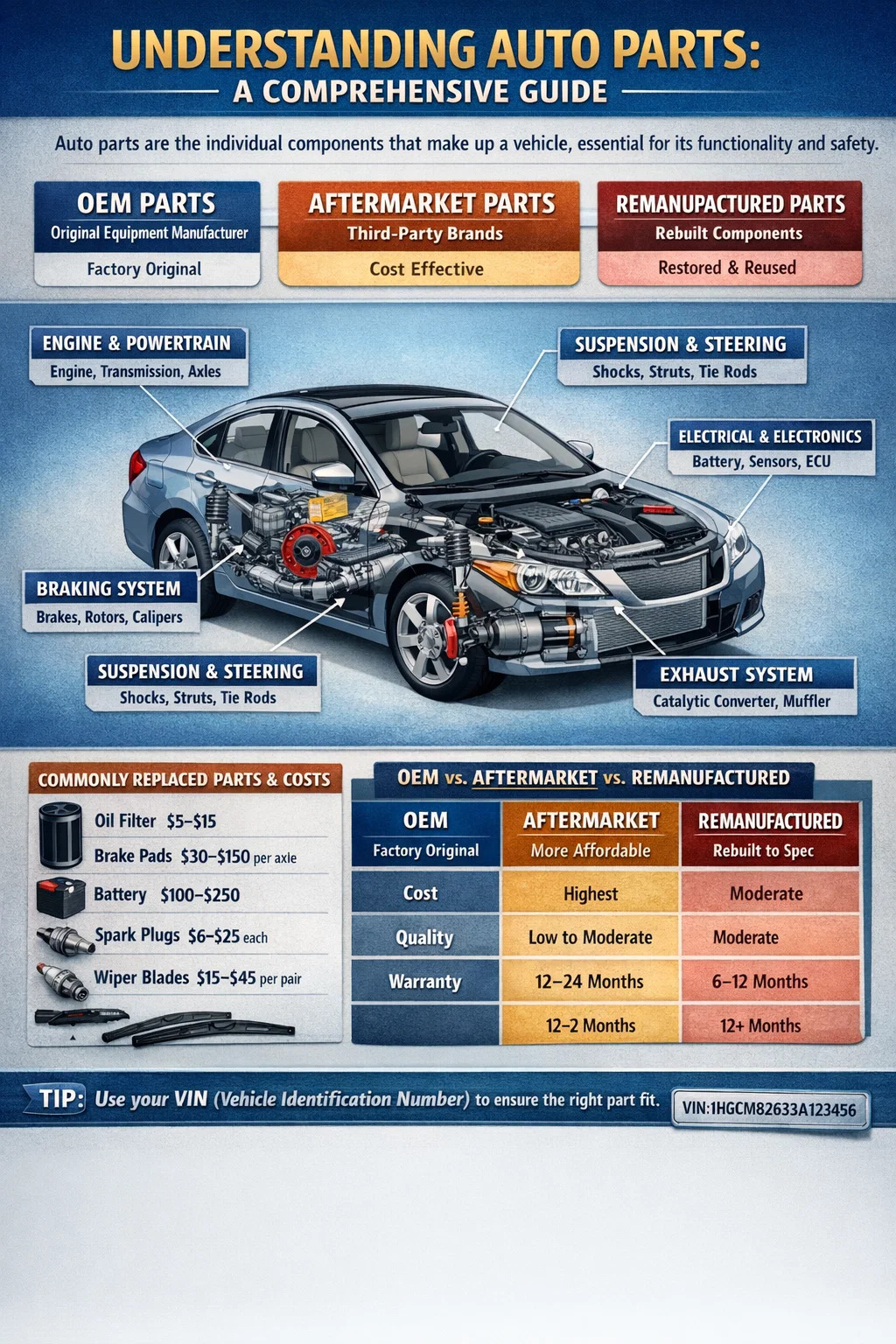
At the most fundamental level, auto parts fall into two broad categories: OEM (Original Equipment Manufacturer) parts and aftermarket parts. OEM parts are produced by or for the vehicle's original manufacturer and are identical to what came with the car from the factory. Aftermarket parts are made by third-party companies and may vary in quality, price, and fit. A third category — remanufactured or rebuilt parts — refers to used components that have been restored to meet original performance specifications.
The Main Categories of Auto Parts Every Car Owner Should Know
A modern passenger vehicle contains between 30,000 and 40,000 individual parts. These parts are grouped into systems, each responsible for a different aspect of vehicle operation. Understanding these systems helps car owners communicate more clearly with mechanics, make smarter purchasing decisions, and recognize early warning signs of component wear.
Engine and Powertrain Components
The engine is the heart of the vehicle, and its auto parts include pistons, crankshafts, camshafts, valves, cylinder heads, gaskets, timing belts or chains, and the oil pan. The powertrain extends beyond the engine to include the transmission, driveshaft, differentials, and axles — all of which work together to transfer engine power to the wheels.
A timing belt, for example, is a relatively inexpensive auto part — typically costing between $25 and $75 for the belt itself — but failure to replace it on schedule (usually every 60,000 to 100,000 miles) can result in catastrophic engine damage costing $2,000 or more. This illustrates why understanding auto parts and their maintenance intervals matters so much financially.
Braking System Parts
Brake system auto parts include brake pads, brake rotors (also called discs), brake calipers, brake lines, the master cylinder, wheel cylinders (in drum brake systems), and brake fluid. These components work together to convert kinetic energy into heat and bring the vehicle to a controlled stop.
Brake pads are among the most frequently replaced auto parts. Most pads last between 25,000 and 65,000 miles depending on driving habits and pad material. Ceramic pads offer longer life and less dust compared to semi-metallic pads, which provide better heat dissipation under heavy use. Replacing brake pads proactively — before they wear down to the metal backing plate — protects the more expensive rotor from damage.
Suspension and Steering Parts
Suspension auto parts include shock absorbers, struts, coil springs, control arms, ball joints, sway bar links, and bushings. Steering components include the steering rack, tie rods, power steering pump, and steering column. These parts work in concert to keep the vehicle stable, absorb road impacts, and allow the driver to control direction.
Worn shock absorbers increase stopping distance by up to 20% and reduce tire contact with the road surface, which is a serious safety concern. Ball joints typically last 70,000 to 150,000 miles, but road conditions, vehicle weight, and maintenance habits significantly affect their lifespan.
Electrical and Electronic Auto Parts
Modern vehicles contain an extensive network of electrical auto parts: the battery, alternator, starter motor, fuses, relays, wiring harnesses, sensors, control modules, and lighting systems. Advanced driver assistance systems (ADAS) have added radar sensors, cameras, ultrasonic sensors, and complex electronic control units (ECUs) to this list.
The average new car in 2024 contains more than 100 electronic control units managing everything from fuel injection timing to seat memory positions. Oxygen sensors, mass airflow sensors, and crankshaft position sensors are among the most commonly replaced electrical auto parts in the aftermarket sector.
Exhaust System Components
Exhaust auto parts include the exhaust manifold, catalytic converter, oxygen sensors, muffler, resonator, and exhaust pipes. The catalytic converter is one of the most valuable auto parts on any vehicle — containing precious metals like platinum, palladium, and rhodium — which is why catalytic converter theft has become a significant problem, with replacement costs ranging from $1,000 to $3,000 or more.
Cooling and Heating System Parts
These auto parts manage engine temperature and cabin comfort. Key components include the radiator, water pump, thermostat, coolant hoses, radiator cap, heater core, and the cabin air conditioning system including the compressor, condenser, and expansion valve. A failing water pump or clogged radiator can cause the engine to overheat within minutes, leading to warped cylinder heads and repairs costing thousands of dollars.
Body and Interior Auto Parts
Body parts include fenders, bumpers, hoods, doors, quarter panels, and windshields. Interior auto parts range from seat assemblies and door panels to dashboards, carpet kits, airbag modules, and seatbelts. These components serve both functional and aesthetic roles. An intact windshield, for instance, contributes up to 30% of a vehicle's structural rigidity in a rollover accident.
OEM vs. Aftermarket vs. Remanufactured: How to Choose the Right Auto Part
One of the most common questions car owners and mechanics face when sourcing vehicle components is whether to buy OEM, aftermarket, or remanufactured auto parts. Each option has distinct advantages and trade-offs depending on the situation.
| Part Type | Cost | Quality Consistency | Best Used For | Warranty Typical |
|---|---|---|---|---|
| OEM | Highest | Guaranteed match | Safety systems, newer vehicles under warranty | 12–24 months |
| Aftermarket | Low to moderate | Variable by brand | Older vehicles, routine maintenance, cost savings | 6–12 months (varies) |
| Remanufactured | Moderate | Meets OEM specs | Alternators, starters, calipers, transmissions | 12 months or more |
For safety-critical components such as airbag modules, ABS units, and structural body parts, OEM is almost always the recommended choice. For routine wear items like air filters, wiper blades, and spark plugs, high-quality aftermarket auto parts from trusted brands such as Bosch, Denso, NGK, or Monroe offer excellent value at 20% to 60% less than OEM prices. Remanufactured parts are particularly cost-effective for expensive assemblies like alternators and power steering racks, where a reman unit can save $150 to $400 compared to new OEM pricing.
How Auto Parts Are Identified: VIN, Part Numbers, and Fitment
One of the most frustrating experiences in buying auto parts is ordering the wrong component for your specific vehicle. Even vehicles with the same make, model, and year can require different auto parts depending on the engine variant, transmission type, trim level, or production date. Proper part identification prevents costly returns and delays.
Using Your VIN to Find the Right Part
The Vehicle Identification Number (VIN) is a 17-character alphanumeric code unique to every vehicle. It encodes the manufacturer, vehicle type, country of origin, engine code, model year, plant of manufacture, and a sequential production number. Most reputable auto parts retailers — whether online or brick-and-mortar — allow you to enter your VIN to filter search results to parts that are confirmed to fit your exact vehicle. Always use your VIN rather than relying solely on year/make/model searches, especially for engine-specific parts like timing components, sensors, and gaskets.
OEM Part Numbers and Cross-Referencing
Every auto part manufactured has a part number assigned by the OEM. These numbers appear on the component itself, in dealer catalogs, and in service manuals. When shopping for an aftermarket alternative, you can cross-reference the OEM part number using tools like the NAPA interchange database, RockAuto's catalog, or manufacturer lookup tools to find compatible aftermarket equivalents. This is particularly useful for discontinued OEM parts where the aftermarket may be the only viable source.
Fitment Notes and Vehicle-Specific Variations
Pay close attention to fitment notes when ordering auto parts online. For example, a 2018 Ford F-150 with the 2.7L EcoBoost engine requires different motor mounts than the same truck equipped with the 5.0L V8. Similarly, vehicles sold in different markets — North America versus Europe, for instance — may use different brake part specifications even when they share a model name. Reading fitment details carefully and checking customer question-and-answer sections on parts listings can save significant time and money.
Most Commonly Replaced Auto Parts and Their Average Costs
While every vehicle has its own maintenance requirements, certain auto parts are replaced far more frequently than others across all vehicle types. Knowing which parts wear out fastest and what they cost helps car owners budget for vehicle upkeep and avoid being surprised by repair bills.
- Oil filter — Replaced every 5,000 to 10,000 miles; cost $5 to $15 for the filter alone. One of the cheapest yet most consequential auto parts to maintain, as dirty oil accelerates engine wear.
- Air filter (engine) — Replaced every 15,000 to 30,000 miles; cost $15 to $40. A clogged engine air filter can reduce fuel efficiency by up to 10%.
- Spark plugs — Standard copper plugs last 30,000 miles; iridium or platinum plugs last 60,000 to 100,000 miles. Cost ranges from $6 to $25 per plug, and a full set for a V6 or V8 engine runs $36 to $200.
- Brake pads — Typically replaced every 25,000 to 65,000 miles; cost $30 to $150 per axle for the parts alone.
- Battery — Most car batteries last 3 to 5 years; replacement cost is $100 to $250 depending on cold-cranking amps and brand.
- Wiper blades — Replaced every 6 to 12 months in most climates; cost $15 to $45 per pair for beam-style blades.
- Cabin air filter — Replaced every 15,000 to 25,000 miles; cost $15 to $50. Often overlooked, but a blocked cabin filter restricts airflow to the HVAC system and reduces A/C effectiveness.
- Oxygen sensors — Typically last 60,000 to 100,000 miles; cost $20 to $100 per sensor. A failing O2 sensor causes poor fuel economy and failed emissions tests.
- Serpentine belt — Replaced every 60,000 to 100,000 miles; cost $25 to $75 for the belt. Failure leaves the vehicle stranded immediately since it drives the alternator, power steering pump, and A/C compressor simultaneously.
- Thermostat — A very inexpensive auto part ($8 to $25), but a stuck-closed thermostat causes rapid overheating and potentially severe engine damage if not caught quickly.
Where to Buy Auto Parts: Retail, Online, and Dealer Options
The channel through which you purchase auto parts significantly affects price, availability, and reliability. Each option suits different situations and buyer profiles.
Auto Parts Retail Chains
Chains like AutoZone, O'Reilly Auto Parts, Advance Auto Parts, and NAPA Auto Parts stock a broad range of commonly needed vehicle components. Their main advantages are same-day availability, free diagnostic services (such as reading OBD-II fault codes), and in-store staff who can help with fitment questions. Prices are typically mid-range — not the cheapest, but competitive for walk-in availability. These retailers also offer free loaner tool programs at many locations, which is useful for DIY repairs requiring specialty tools.
Online Auto Parts Retailers
Online marketplaces and dedicated auto parts websites offer the widest selection and often the lowest prices. RockAuto, for instance, carries parts for vehicles dating back to the early 1900s and typically offers prices 30% to 60% lower than retail chain pricing on equivalent parts. Amazon, eBay Motors, and CarParts.com are also significant sources. The trade-off is shipping time — typically 2 to 7 days — which is impractical when your vehicle is disabled and needs an immediate fix. Online buying is ideal for planned maintenance, slow-moving repairs, or when sourcing hard-to-find components for older or rare vehicles.
Dealership Parts Departments
Dealership parts counters sell genuine OEM auto parts directly from the manufacturer's supply chain. This is the most reliable source for parts where an exact factory-spec match is critical — especially for vehicles still under warranty, or for recalls and technical service bulletin (TSB) repairs. Prices are the highest of any channel, but the guarantee of exact fitment and access to the dealer's technical support resources can justify the premium in many cases.
Salvage Yards and Used Auto Parts
Also called junkyards or auto recyclers, salvage yards are an excellent source for used auto parts at very low prices. Interior trim pieces, body panels, mirrors, and glass are especially good candidates for used sourcing, as these parts often retain full function even after years on a donor vehicle. Databases like Car-Part.com aggregate inventory from salvage yards across the country and allow you to search for specific parts by make, model, and year. Used mechanical parts like engines and transmissions are also available with mileage disclosures, though they carry more risk than new or remanufactured alternatives.
Quality Indicators: How to Evaluate an Auto Part Before You Buy
Not all auto parts are created equal. The aftermarket is saturated with products ranging from high-quality components that match or exceed OEM standards to poorly manufactured parts that fail within months. Knowing how to evaluate quality before purchasing saves money and prevents safety risks.
- Brand reputation: Established brands with long track records — such as Bilstein for shocks, Gates for belts and hoses, Brembo for brake components, and ACDelco for GM-specific parts — are generally safer choices than unknown generic brands with no verifiable manufacturing standards.
- Certifications and standards: Look for parts certified by recognized bodies such as IATF 16949 (automotive quality management), SAE International standards, or CAPA (Certified Automotive Parts Association) for collision replacement parts. These certifications indicate the manufacturer follows documented quality control processes.
- Warranty terms: A manufacturer willing to back an auto part with a 1- to 3-year warranty has confidence in their product's durability. Short or non-existent warranties on mechanical parts are a red flag.
- Packaging and labeling: Legitimate auto parts typically come in professional packaging with clear part numbers, application guides, and installation instructions. Generic or poorly labeled packaging with spelling errors or vague descriptions is often a sign of low-quality or counterfeit merchandise.
- Customer reviews and fitment feedback: Reading verified buyer reviews — specifically those that mention vehicle type, installation experience, and long-term performance — provides real-world quality data that manufacturer claims cannot replace.
Auto Parts for Electric Vehicles: What's Different
Electric vehicles (EVs) share many auto parts with conventional internal combustion engine (ICE) vehicles — tires, brakes, suspension components, body panels, lights, and interior parts are largely the same. However, EVs eliminate or replace a significant number of traditional auto parts, and introduce new categories that the aftermarket is only beginning to support.
EVs do not require spark plugs, oil filters, timing belts, fuel injectors, exhaust systems, or traditional transmission fluid. Instead, they introduce high-voltage battery packs, battery management systems (BMS), electric motors, regenerative braking controllers, thermal management systems for battery cooling, and onboard charger modules. Many of these components are proprietary and currently only available through OEM channels.
Battery degradation is the primary long-term concern for EV owners. Most EV batteries retain 70% to 80% of their original capacity after 100,000 miles, according to real-world data from Tesla and third-party EV fleet studies. Battery replacement — when necessary — remains expensive, typically ranging from $5,000 to $20,000 depending on vehicle and battery size. The aftermarket is beginning to address this with remanufactured and refurbished battery modules, particularly for higher-volume EVs like the Nissan Leaf and early Tesla Model S.
Brake parts for EVs last significantly longer than on conventional vehicles because regenerative braking handles the majority of deceleration, reducing mechanical brake pad wear by as much as 50% in urban driving conditions. This means brake pads and rotors on a well-maintained EV may last 80,000 to 100,000 miles or more before replacement is needed.
DIY vs. Professional Installation: Knowing When Each Makes Sense
Purchasing an auto part is only half the job — it still needs to be installed correctly. Many car owners choose to handle routine replacements themselves, while others prefer professional installation for more complex or safety-critical repairs. The right choice depends on the part involved, your mechanical ability, and the tools you have access to.
Auto Parts Well-Suited for DIY Replacement
- Air filters (engine and cabin) — Typically tool-free and completed in under 10 minutes
- Wiper blades — Snap-fit replacement requiring no tools
- Spark plugs — Straightforward on most 4-cylinder engines with basic socket set
- Battery replacement — Accessible on most vehicles with basic hand tools
- Brake pads (front or rear) — Doable with basic tools, jack stands, and a caliper piston tool
- Headlight and taillight bulbs — Usually accessible with basic tools or no tools
- Oil and oil filter change — A fundamental DIY maintenance task for any mechanically inclined owner
Auto Parts That Typically Require Professional Installation
- Airbag modules and clockspring assemblies — Require disabling the SRS system safely and proper calibration
- Transmission replacement or rebuild — Complex, heavy, and requires a transmission jack and diagnostic equipment
- Timing belt or chain service — Incorrect installation results in catastrophic engine failure
- Wheel alignment components (control arms, tie rods) — Require alignment machine calibration after installation
- Fuel system components — Require fuel pressure release procedures and fire safety precautions
- ADAS sensors and cameras — Require OEM or specialized scan tool calibration after replacement
Labor costs at independent repair shops average $75 to $130 per hour in the United States, while dealership labor rates frequently run $130 to $200 per hour or more. Sourcing the auto part yourself and supplying it to a mechanic — a practice sometimes called "customer-supplied parts" — can save money, though some shops charge additional fees or offer no warranty on customer-supplied components.
Understanding Auto Part Warranties and Return Policies
Warranty terms for auto parts vary widely depending on the manufacturer, retailer, and type of component. Reading and understanding these terms before purchasing protects you financially if a part fails prematurely.
Most aftermarket auto parts sold through major retail chains carry a limited lifetime warranty — meaning they will replace the part if it fails due to a manufacturing defect, but not due to improper installation or normal wear. In practice, this means keeping your receipt and original packaging, and returning the defective part to the same retail chain location where it was purchased.
Online retailers typically offer 30- to 90-day return windows for uninstalled parts in original packaging, with restocking fees ranging from 15% to 25% on some platforms. Once an auto part has been installed and is found to be defective, the warranty claim process becomes more complex and usually requires proof of proper installation.
For high-value components like remanufactured engines or transmissions, warranties are typically expressed in both time and mileage — for example, "3 years or 100,000 miles, whichever comes first." Some suppliers require warranty registration within 30 days of purchase to activate coverage. Always read the fine print, particularly regarding labor cost coverage — most part warranties cover the replacement part only, not the labor required to install it a second time if it fails.
The Role of Auto Parts in Vehicle Safety
Beyond keeping a vehicle running, properly maintained auto parts are fundamental to road safety — not just for the vehicle's occupants, but for other road users as well. Worn or substandard components directly increase the risk of accidents, mechanical breakdowns, and roadside hazards.
According to the National Highway Traffic Safety Administration (NHTSA), vehicle component failure contributes to approximately 2% of all traffic crashes in the United States, but this figure rises significantly when tire failures, brake deficiencies, and lighting problems are included. Tire-related crashes alone account for more than 600 fatalities annually in the U.S.
Critical safety-related auto parts that should never be compromised on quality include brake pads and rotors, tires, steering components, lighting systems, seatbelts and pretensioners, airbag modules, and suspension components. Using counterfeit or grossly substandard versions of these parts to save money creates risks that far outweigh any financial benefit.
Vehicle recalls are another important dimension of auto part safety. The NHTSA manages recall databases where any vehicle owner can check whether their car has open recalls — some of which involve free replacement of defective parts by the manufacturer. Checking recall status using your VIN at NHTSA.gov is a free service that every vehicle owner should use periodically.