 English
 Español
Content
- 1 What You Need to Know About a Car: The Essential Starting Point
- 2 The Engine: The Heart of Every Vehicle
- 3 The Transmission: Connecting Power to Motion
- 4 The Cooling System: Keeping the Engine at the Right Temperature
- 5 The Electrical System: Battery, Alternator, and Starter
- 6 The Braking System: The Most Critical Safety Automobile Part
- 7 Steering and Suspension: Control, Comfort, and Handling
- 8 The Exhaust System: More Than Just a Tailpipe
- 9 Drivetrain Components: How Power Reaches the Wheels
- 10 Fuel System Components Every Driver Should Understand
- 11 Most Commonly Replaced Automobile Parts and What They Cost
- 12 OEM vs. Aftermarket Parts: What's the Difference and Which Should You Choose?
- 13 Dashboard Warning Lights: What Automobile Parts Are Telling You
- 14 Basic Maintenance Tasks That Extend the Life of Every Automobile Part
- 15 What to Know When Buying a Used Car: Evaluating Automobile Parts Condition
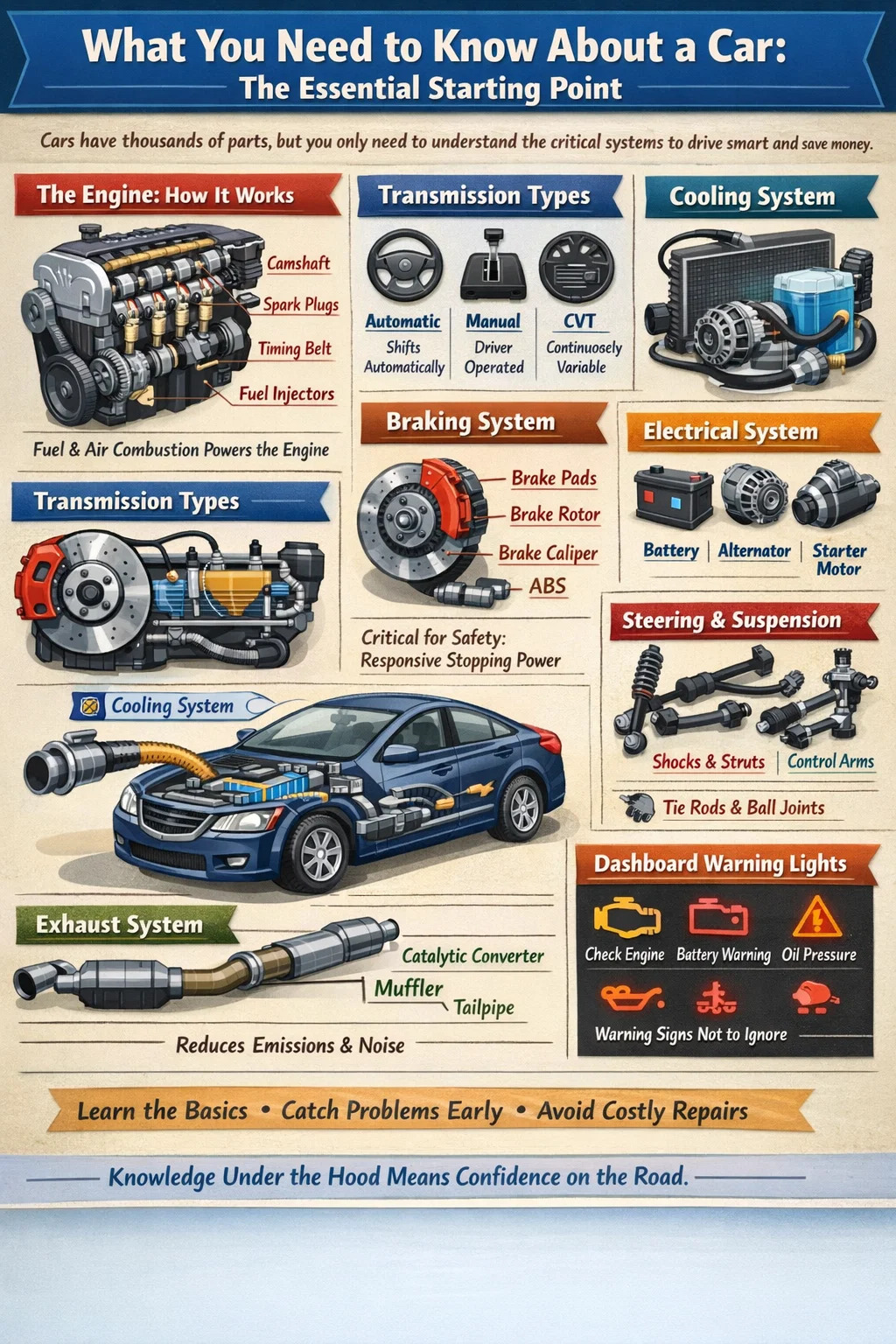
What You Need to Know About a Car: The Essential Starting Point
Every car on the road is a collection of interconnected systems, and you don't need to be a mechanic to understand them. A typical vehicle contains roughly 30,000 individual parts, but the vast majority of car owners only ever need to understand a fraction of them to stay safe, save money, and make informed decisions at the repair shop. This guide walks through the automobile parts and systems that actually matter to everyday drivers — from what sits under the hood to what keeps your ride smooth and your brakes responsive.
Whether you're a first-time buyer, a new driver, or someone tired of nodding along at the mechanic, knowing your car's key components gives you real confidence. You'll catch warning signs earlier, ask better questions, and avoid repairs you don't actually need.
The Engine: The Heart of Every Vehicle
The engine is the most critical automobile part in any gas-powered vehicle. It operates on a principle called internal combustion — fuel and air are mixed inside cylinders, ignited by spark plugs, and the resulting explosions push pistons up and down. That up-and-down motion is converted into rotation by the crankshaft, which ultimately powers your wheels.
Inside the engine block, you'll find several components working in tight coordination:
- Pistons and connecting rods — convert combustion force into rotational motion via the crankshaft.
- Camshaft — controls the timing of intake and exhaust valves. A failing camshaft can cost $1,500 to $3,000 to replace, making it one of the most expensive engine components.
- Spark plugs — ignite the air-fuel mixture in each cylinder. Worn spark plugs cause misfires, rough idling, and poor fuel economy. Replacement typically runs $100 to $250.
- Fuel injectors — electronic nozzles that spray precise amounts of fuel into each cylinder for combustion.
- Timing belt or chain — keeps the crankshaft and camshaft synchronized. A snapped timing belt can destroy an engine in seconds, which is why manufacturers recommend replacing it every 60,000 to 100,000 miles.
- Valves — located at the top of each cylinder, they open and close to let air and fuel in and push exhaust gases out.
Electric vehicles replace the internal combustion engine with one or more electric motors powered by high-voltage battery packs. EVs have far fewer moving parts, which generally means lower long-term maintenance costs — but the battery pack itself is the major expense, often ranging from $5,000 to $15,000 or more to replace.
Engine Lubrication: Oil Pump and Oil Filter
The oil pump circulates engine oil continuously to reduce friction between moving metal parts. Without it, your engine would overheat and seize within minutes. The oil filter works alongside the pump, trapping dirt, metal debris, and contaminants before they can damage engine internals. Oil filters typically need to be changed every 3,000 to 7,500 miles depending on the type of oil used and your vehicle's specifications — it's one of the cheapest and most impactful automobile part maintenance tasks you can do yourself.
The Air Filter: Often Overlooked, Always Important
Every combustion engine needs a steady supply of clean air to run efficiently. The air filter prevents dust, pollen, and debris from entering the engine. A clogged air filter restricts airflow, directly reducing fuel efficiency — some studies suggest a severely clogged filter can reduce fuel economy by up to 10%. Replacement costs are minimal, usually $20 to $50 for the part alone, and most drivers can swap it in under 10 minutes.
The Transmission: Connecting Power to Motion
The transmission is the automobile part that takes raw power from the engine and delivers it to the wheels in a usable form. It does this by adjusting gear ratios — lower gears provide more torque for acceleration and hill climbing, while higher gears allow efficient cruising at highway speeds.
There are three main types of transmissions found in modern vehicles:
- Automatic transmission — shifts gears independently without driver input, using a hydraulic torque converter and a complex set of planetary gears. Most popular in the U.S. market.
- Manual transmission — requires the driver to manually select gears using a clutch pedal and gear stick. Offers more driver control and can be more fuel-efficient when driven correctly.
- CVT (Continuously Variable Transmission) — uses a belt-and-pulley system to provide seamless acceleration without distinct gear changes. Common in fuel-efficient compact cars and hybrids.
Transmission repairs are among the most expensive in automotive service, often ranging from $1,800 to $3,500 for a rebuild or replacement. Warning signs include delayed gear engagement, slipping between gears, unusual whining noises, and transmission fluid leaks — a bright red or dark brown puddle under the vehicle warrants immediate attention.
The Cooling System: Keeping the Engine at the Right Temperature
An engine running at full load generates enormous heat. The cooling system's job is to absorb that heat and dissipate it before it causes damage. A properly functioning cooling system is critical — engine overheating is one of the leading causes of catastrophic engine failure.
The key automobile parts within this system include:
- Radiator — the central component of the cooling system. Coolant flows through the engine, absorbs heat, then cycles into the radiator where it releases that heat to outside air passing through the fins. A failed radiator can result in rapid overheating and engine damage.
- Water pump — a belt-driven or electric pump that circulates coolant through the engine and radiator. It uses an impeller to keep coolant moving continuously.
- Cooling fan — draws air through the radiator when the vehicle is stationary or moving slowly. Most modern vehicles use electric fans that activate when engine temperature reaches a set threshold.
- Thermostat — regulates coolant flow based on engine temperature, allowing the engine to warm up quickly and then maintaining optimal operating temperature.
- Coolant hoses — reinforced rubber hoses that carry coolant between the radiator, thermostat housing, heater core, and engine. Cracked or collapsed hoses are a common cause of cooling system failure.
Coolant (antifreeze) should be flushed and replaced according to your vehicle's service schedule — typically every 30,000 to 50,000 miles. Running on old, degraded coolant accelerates corrosion inside the cooling system and reduces heat transfer efficiency.
The Electrical System: Battery, Alternator, and Starter
Modern vehicles are increasingly dependent on electronics, and three automobile parts sit at the core of the electrical system: the battery, the alternator, and the starter motor.
Car Battery
The battery stores electrical energy in chemical form and delivers it on demand. It powers everything from the starter motor that cranks the engine to the headlights, infotainment system, and power windows. Without a functioning battery, the car simply won't start. Most car batteries last between 3 and 5 years, with replacement costing between $100 and $200 in most cases. Extreme temperatures — both heat and cold — accelerate battery degradation significantly.
Alternator
While the battery starts the car, the alternator keeps it running. Once the engine is on, the alternator generates electricity to power all vehicle systems and recharge the battery simultaneously. Common failure signs include a dimming dashboard, flickering lights, and a battery warning light on the instrument cluster. Replacement typically costs between $400 and $600. Interestingly, it's often just one internal component — such as worn bearings or a failed diode — that causes alternator problems, so a complete replacement isn't always necessary.
Starter Motor
The starter motor uses electrical energy from the battery to crank the engine and initiate combustion. A clicking sound when you turn the key — without the engine turning over — usually points to a weak battery or failing starter. Starter motors typically last 100,000 to 150,000 miles, but they can fail earlier in high-cycle usage environments like stop-and-go city driving.
Ignition Coil
The ignition coil steps up battery voltage to around 30,000 volts — the level needed to create a spark inside each cylinder. If your car backfires frequently or stalls without warning, a faulty ignition coil may be the cause. Mechanics generally recommend replacement around the 100,000-mile mark, though leaking engine fluids can damage coils earlier.
The Braking System: The Most Critical Safety Automobile Part
Of all the automobile parts on your vehicle, the braking system is arguably the most directly tied to your safety. Most modern vehicles use disc brakes on all four wheels, though some still have drum brakes on the rear axle.
Here's how disc brakes work: when you press the brake pedal, hydraulic pressure forces the brake calipers to squeeze brake pads against spinning metal discs called rotors. The friction between the pads and rotors converts kinetic energy into heat, slowing the vehicle. This is why brakes get hot during heavy use — and why you should never ignore the smell of burning friction material.
Key components of the braking system:
- Brake pads — the friction material that clamps onto the rotor. Most pads include a wear indicator that produces a high-pitched squeal when they need replacing. Standard replacement intervals range from 25,000 to 70,000 miles depending on pad material and driving habits.
- Brake rotors — the metal discs against which brake pads press. Rotors can warp from heat cycling, causing a pulsing sensation in the brake pedal.
- Brake calipers — hydraulic clamps that hold the brake pads and squeeze them against the rotor when pressure is applied.
- ABS (Anti-lock Braking System) — prevents wheels from locking up during hard braking, particularly on slippery surfaces. The ABS modulates brake pressure many times per second to maintain steering control during emergency stops.
| Component | Typical Lifespan | Average Replacement Cost | DIY Friendly? |
|---|---|---|---|
| Brake Pads | 25,000 – 70,000 miles | $150 – $300 per axle | Yes, with basic tools |
| Brake Rotors | 50,000 – 70,000 miles | $200 – $400 per axle | Moderate skill required |
| Brake Calipers | 75,000 – 100,000 miles | $300 – $800 per caliper | Professional recommended |
| Brake Fluid | Every 2 years or 30,000 miles | $70 – $120 | Yes |
Steering and Suspension: Control, Comfort, and Handling
The steering and suspension systems are what connect your inputs at the steering wheel to the actual movement of the tires on the road. They also absorb road imperfections to keep the ride comfortable and maintain tire contact with the pavement.
Power Steering System
The power steering gear (also called a steering rack) converts your rotational input at the steering wheel into linear motion that physically turns the front wheels. Older systems use hydraulic power steering pumps to assist this process. Most newer vehicles have switched to electric power steering (EPS), which is more efficient and eliminates the need for power steering fluid. Common steering problems include looseness, pulling to one side, and unusual sounds when turning.
Suspension Components
A well-functioning suspension system keeps all four tires planted firmly on the road. Front and rear suspension systems typically include:
- Shock absorbers — hydraulic devices that dampen the up-and-down movement of the suspension springs. They typically last 50,000 to 100,000 miles. Worn shocks cause excessive bouncing, poor handling, and uneven tire wear.
- Struts — a combined shock absorber and structural support component, common in front-wheel-drive vehicles. They also help maintain proper wheel alignment.
- Ball joints — allow the suspension and steering knuckles to rotate. Worn ball joints cause clunking noises over bumps and can be a serious safety hazard if they fail.
- Tie rod ends — link the steering rack to the wheel hubs. Loose tie rod ends cause excessive play in the steering wheel and unpredictable handling.
- Control arms and CV joints — connect the wheel hubs to the vehicle frame and allow the wheels to move through their range of motion. A clicking sound when turning sharply often indicates a failing CV joint.
Front and Rear Axles
The front axle is where the front wheel hubs attach and is part of the steering system. The rear axle serves as the mounting point for the rear wheels and is a key component of the rear suspension. On rear-wheel-drive vehicles, the rear axle also transmits engine torque to the wheels through the differential — an automobile part that allows the two rear wheels to rotate at different speeds during cornering.
The Exhaust System: More Than Just a Tailpipe
Most drivers see nothing more than a tailpipe at the back of their car, but the exhaust system is a multi-component network that routes combustion byproducts safely away from the vehicle while also reducing noise and harmful emissions.
The primary automobile parts in the exhaust system are:
- Exhaust manifold — collects exhaust gases from the engine's cylinder heads and funnels them into the exhaust pipe.
- Catalytic converter — one of the most important emissions control devices in any modern vehicle. It converts dangerous pollutants like carbon monoxide, hydrocarbons, and nitrogen oxides into water vapor, carbon dioxide, and nitrogen. Catalytic converters have become a frequent target for theft due to their precious metal content (platinum, palladium, rhodium), with replacement costs running $1,000 to $3,000 or more.
- Muffler — reduces the sound created by engine exhaust pulses. A rusted or damaged muffler produces a noticeably louder exhaust note and may cause the vehicle to fail an emissions or noise inspection.
- Resonator — works alongside the muffler to cancel out specific sound frequencies, resulting in a quieter and smoother exhaust note.
- Tailpipe — the final section of the exhaust system, directing gases away from the rear of the vehicle and away from passengers.
Exhaust leaks — most commonly caused by corrosion — can be dangerous because carbon monoxide can seep into the cabin. If you smell exhaust inside the vehicle with the windows closed, have the system inspected immediately.
Drivetrain Components: How Power Reaches the Wheels
The drivetrain is the collection of automobile parts that transfers rotational force from the transmission to the drive wheels. Depending on your vehicle's drivetrain configuration — front-wheel drive (FWD), rear-wheel drive (RWD), all-wheel drive (AWD), or four-wheel drive (4WD) — the specific components vary, but several are common across platforms.
- Driveshaft — on RWD and 4WD vehicles, the driveshaft transmits torque from the transmission to the rear differential. It must be properly balanced; an imbalanced driveshaft causes vibration at highway speeds.
- Differential — allows the driven wheels to rotate at different speeds during turns. A vehicle turning a corner requires the outer wheel to travel farther than the inner wheel — without a differential, tires would scrub and handling would suffer dramatically.
- CV axles and joints — transmit torque from the transmission to the drive wheels while allowing for steering movement and suspension travel. Most FWD vehicles use CV axles as the primary power delivery component.
- Clutch (manual vehicles) — connects and disconnects the engine from the transmission to allow gear changes. Signs of clutch wear include a spongy pedal feel, difficulty engaging gears, vibrations during engagement, and a burning smell under hard use.
Fuel System Components Every Driver Should Understand
The fuel system stores gasoline and delivers it to the engine at the right pressure and quantity for efficient combustion. Several automobile parts make this possible.
- Fuel tank — typically located ahead of the rear axle for safety, specifically to reduce crumple zone overlap in rear-end collisions. Most passenger cars carry between 12 and 18 gallons.
- Fuel pump — a high-pressure pump (usually electric and submerged in the fuel tank) that delivers fuel to the injectors at consistent pressure. Running a tank near empty regularly can shorten fuel pump life, as the fuel itself acts as a coolant for the pump.
- Fuel filter — traps contaminants before they reach the fuel injectors. A clogged fuel filter causes hard starting, rough idling, and power loss under acceleration.
- Fuel injectors — electronically controlled nozzles that spray atomized fuel directly into the intake port or cylinder. Dirty injectors cause poor combustion and reduced fuel economy.
Most Commonly Replaced Automobile Parts and What They Cost
Knowing which automobile parts wear out most often helps you budget for maintenance and avoid being caught off guard. The list below reflects what mechanics replace most frequently across all vehicle types and mileages.
| Part | Avg. Replacement Cost | Typical Interval | DIY Possible? |
|---|---|---|---|
| Oil Filter | $5 – $20 | Every oil change | Yes |
| Air Filter | $20 – $50 | 15,000 – 30,000 miles | Yes |
| Wiper Blades | $20 – $50 per pair | 6 – 12 months | Yes |
| Spark Plugs | $100 – $250 | 30,000 – 100,000 miles | Yes, basic skill |
| Car Battery | $100 – $200 | 3 – 5 years | Yes |
| Brake Pads | $150 – $300 per axle | 25,000 – 70,000 miles | Yes, with tools |
| Alternator | $400 – $600 | 80,000 – 150,000 miles | Moderate skill |
| Catalytic Converter | $1,000 – $3,000+ | As needed / 100,000+ miles | Professional recommended |
The frequency with which any specific automobile part wears out depends heavily on driving conditions, climate, and maintenance habits. City driving with constant stop-and-go traffic wears brakes and transmission components faster than highway driving. Extreme heat accelerates battery degradation. Dusty environments clog air and oil filters more quickly.
OEM vs. Aftermarket Parts: What's the Difference and Which Should You Choose?
When an automobile part needs replacing, you'll typically have two choices: Original Equipment Manufacturer (OEM) parts or aftermarket alternatives. Each has genuine advantages and tradeoffs.
OEM Parts
OEM parts are manufactured to the exact specifications set by the vehicle's maker. They're guaranteed to fit perfectly and perform as intended. They typically come with manufacturer warranties and are the safest choice for complex safety-critical systems like ABS modules, airbag sensors, or steering components. The downside is cost — OEM parts often carry a significant premium over aftermarket alternatives, sometimes 20% to 60% more expensive.
Aftermarket Parts
Aftermarket parts are made by third-party manufacturers. Quality varies enormously — some aftermarket suppliers produce parts that meet or exceed OEM specifications, while others cut corners with inferior materials. For routine consumables like air filters, oil filters, wiper blades, and even spark plugs, high-quality aftermarket options often represent excellent value. For safety systems and precision-fit components, sticking with OEM or a well-reviewed aftermarket brand with a solid warranty is strongly advisable.
A practical rule: always verify that a part is compatible with your vehicle's year, make, model, and engine size before purchasing. Even parts designed for the same car model can differ significantly between trim levels and production years.
Dashboard Warning Lights: What Automobile Parts Are Telling You
Modern vehicles use onboard diagnostic systems to monitor hundreds of parameters. When a sensor detects a problem, it triggers a dashboard warning light. Knowing which light corresponds to which automobile part or system saves time, money, and potential safety risks.
- Check Engine Light (CEL) — one of the most commonly misunderstood lights. It can indicate anything from a loose gas cap to a failing catalytic converter or oxygen sensor. A blinking CEL typically indicates an active misfire that can damage the catalytic converter — this warrants immediate attention.
- Battery Warning Light — usually indicates an issue with the alternator, battery, or charging system. Don't ignore this one — if the alternator fails while driving, the car will eventually shut down completely.
- Oil Pressure Warning Light — this is a red alert. Low oil pressure can destroy an engine in minutes. Pull over safely and shut the engine off immediately if this light appears while driving.
- Temperature Warning Light — indicates the engine is overheating. Continuing to drive risks catastrophic damage to the cylinder head gasket and engine block.
- TPMS (Tire Pressure Monitoring System) — alerts you to a tire with significantly low pressure. Under-inflated tires increase stopping distances, reduce fuel efficiency, and accelerate uneven tread wear.
- Brake Warning Light — may indicate low brake fluid, worn brake pads, or an ABS malfunction depending on the specific symbol displayed.
Basic Maintenance Tasks That Extend the Life of Every Automobile Part
Understanding your car's components is only half the equation. Knowing how to maintain them is what keeps those parts working for the long haul. Regular maintenance is consistently shown to be far cheaper than reactive repair — in many cases, a $30 oil change prevents a $5,000 engine replacement.
- Change the engine oil on schedule. Whether you're on a 3,000-mile conventional oil schedule or a 7,500-mile synthetic interval, consistency matters more than the specific number. Fresh oil keeps moving parts lubricated and prevents sludge buildup.
- Inspect and replace the air filter annually or every 15,000 to 30,000 miles, whichever comes first. In dusty or high-pollution environments, check it more frequently.
- Check tire pressure monthly. Correct inflation reduces fuel consumption and extends tire life. Most vehicles specify 32 to 35 PSI for standard passenger tires.
- Flush coolant at the recommended interval. Degraded coolant becomes acidic and corrodes cooling system components from the inside.
- Replace timing belts proactively. Don't wait for a timing belt to snap — replacement on schedule is far cheaper than an interference engine destroyed by a broken belt.
- Have brakes inspected annually or whenever you notice squealing, grinding, or pulsation in the brake pedal.
- Keep the fuel tank at least one-quarter full to avoid straining the fuel pump, which uses fuel as a coolant.
- Rotate tires every 5,000 to 7,500 miles to ensure even tread wear across all four positions.
None of these tasks require advanced mechanical knowledge. Many are doable with basic tools in a driveway, and even those best left to a professional are straightforward, affordable services when performed on schedule rather than in an emergency.
What to Know When Buying a Used Car: Evaluating Automobile Parts Condition
When buying a used vehicle, your knowledge of automobile parts becomes a direct financial tool. A car that looks clean on the outside may be hiding significant mechanical wear underneath.
Before committing to any used vehicle purchase, inspect or have inspected:
- Engine oil condition — pull the dipstick and look at the oil. Black, gritty oil suggests infrequent changes. Milky or foamy oil indicates coolant mixing with oil, which often points to a blown head gasket — an expensive repair.
- Brake pad thickness — if visible through the wheel spokes, brake pads should have at least 3mm of material remaining. Less than that means imminent replacement costs.
- Tire tread depth and wear patterns — uneven wear suggests alignment or suspension problems. Bald tires need immediate replacement. A new set of four tires can cost $400 to $1,000 or more.
- Transmission behavior — during a test drive, note any hesitation, slipping, or rough shifts. These suggest a transmission that may need attention soon.
- Suspension and steering feel — clunking over bumps, pulling to one side, or excessive play in the steering wheel all point to worn suspension components.
- OBD-II diagnostic scan — a $20 OBD-II scanner plugged into the vehicle's diagnostic port reveals stored fault codes, even if the check engine light has been cleared by the seller. This is one of the most valuable steps you can take before purchasing a used vehicle.
A pre-purchase inspection by an independent mechanic typically costs $100 to $150 and can reveal issues that save you thousands. Any reputable seller will allow this inspection — reluctance is itself a warning sign.